Bits and bobs

Random thoughts about random things by a random person


4 Comments

Navigating chronic pain – My journey with cancer (Part 11)

Hi folks!

The title of this post should definitely give you some strong vibes as to what we’ll be talking about today. It’s not exactly subtle. 😉

Before we jump into it, I want to preface this by saying I’m not explaining all this from a place of “Please pity me.” It’s simply, as with all the posts about cancer, for informational purposes. Perhaps my experience might help someone else – whether someone dealing with cancer and/or pain issues or who has someone in their life dealing with those things.

And so it begins – again

If you’ve been following along, you know that there have been different types of pain in this journey, but up until late spring or early summer, it had all been related to the radiation and/or chemo. None of it had been attributable to the cancer site itself, so this is another new phase of things.

In the March sigmoidoscopy, the surgeon took a few biopsies to confirm for sure that cancer cells were still at the original site as well as how prevalent and aggressive they were. They also did biomarker testing on the cells.

After that scope, things were a bit tender and slightly uncomfortable in the rectum. I figured it was because of all the snips that were taken and assumed it would get better as the snipped tissue areas healed.

Such has not been the case. In fact, the complete opposite has happened. The slight discomfort moved to strong discomfort, and then into full-on pain. The big switch happened while I was home visiting in Newfoundland. Since then it’s been growing almost exponentially.

Sources of pain

If I’m lying down, it’s not too bad. It can get bad even then when (so it seems) the rectum is filling up and, I think, pressure is being put on the tumour site. The skin there is raw and ulcerated and there are a lot of nerve endings, so that makes sense.

It gets really bad, though, when I am standing up. I reached a point where within about 30 to 60 seconds (literally) of standing up, the pain activates to where I need to lie down again for it to pass. Needless to say, you can’t get very much done in 30 to 60 seconds, so it has been a bit frustrating.

That said, I have become pretty proficient at getting dressed and even folding laundry while lying down! Whole new skill sets – look at me go!

Sometimes it wakes me up at night and keeps me awake, but usually I can get back to sleep before too terribly long. Last night, though, it didn’t wake me up at all – yippee!!!

Going to the bathroom is an issue again. I shouldn’t be surprised, given that it’s rectal cancer, but I was surprised that it affects urination. As the pressure and, therefore, pain at the site increase, the muscles go into protection mode and contract. That keeps anything from happening.

I have learned that there is no point even trying to go to bathroom when the pain is active, no matter how full my bladder is. I have to lie down until the pain subsides, or at least lessens substantially, and then I can go.

And because the muscles want to keep everything locked up tighter than a drum, there is some additional pain from fissures that sometimes happen when I have bowel movements.

Also, at this point, the pain is no longer just in the tumour site itself. Many parts of the pelvic region become uncomfortable with the activation of the pain. The pelvic muscles are all linked in together, so while it’s another layer of unpleasantness, it’s not a surprise.

Medications

Medication-wise, initially I had tried acetaminophen, but it really didn’t make any difference so I don’t bother with it now. I have been sticking to ibuprofen and naproxen instead.

I usually take naproxen in the morning and at night before bed, as it has a longer effect time. (That’s not the right way to say that, but I don’t know what is, so that’s what we’re going with!) Then in the later afternoon I will take an ibuprofen to help get through the evening.

On the strong urging of my oncology social worker, pharmacist, and physiotherapist, I reached out to the oncology Patient Support Line and was able to get an appointment with my main oncologist last week. I updated him on the changes to the pain (strength and location) and we talked about some options.

Even though the ibuprofen and naproxen are over-the-counter medications, there are concerns about using them long term, so I asked him about that and he’s good with it since I’m just using them at the lowest doses possible and they are helping.

He also prescribed a steroid ointment that I can use internally and externally. It helps heal the skin and because the tumour is so low, it might also provide some relief to that pain. I have been using it since Wednesday evening and it definitely does help with the whole BM experience. I keep thinking of the Charmin toilet paper tag line: “Enjoy the go.” It means so much more now!

He added that if it doesn’t help there are “plans B, C, D, E, and F” that we can try, as well. He only wants to try one thing at a time so we can measure what’s most effective, which makes sense to me!

Other options

There are much stronger meds I could try, but, as I might have mentioned previously, I don’t want to start on any narcotics just yet. I know the pain will get worse, especially depending on if/when/where this spreads, so I don’t want to build up tolerances to it now. Those are on the table for later.

The oncologist also told me that if I want to look into chemo to help address the pain, to let him know and he can let the medical oncologist know.

CBD (from cannabis) has been suggested by a friend, but it is a bit too unstudied for me to want to throw it in the mix. I have a few different medications I am on and it can negatively interact with them. I’m in a place right now of just wanting to try some tried-and-true methods. Maybe down the road I’ll be willing to take the risk of the not-so-well-known, but not right now.

Other management methods

In addition to the drug side of things, I have also been using and learning about some other methods to help live with and manage the pain.

I have a massage gun that sometimes helps when I use it at low speed on my lower glutes. I have to say that as the pain has progressed, that has become less effective, but helping even sometimes is better than not helping at all!

A couple of weeks ago my oncology social worker suggested this program Progress Over Pain (POP) that is available for free in Ontario – or at least eastern Ontario. It is a small virtual group setting and provides tips primarily from a cognitive behavioural therapy perspective. Happily the next session was starting the day after she and I spoke and I was able to get slotted in for it. Serendipity! There are 6 sessions, Wednesday evenings for 2 hours. We are half-way through them and I’m finding them quite helpful.

My physiotherapist, who has a focus on oncology and a certification in pelvic health, provided me with some stretches and visualization exercises to help things relax in the pelvic area and address the bathroom issues. I have been finding success with that, too. I’m not perfect – distraction should be my middle name – but I’m getting better at it!

Speaking of distraction, one of the things I have learned in the POP program is that it’s important to find ways to not focus on the pain – to distract yourself from it. If you focus on it, the brain pays more attention to it and, frequently, amplifies it. (NOTE: This is my interpretation of what I learned about it – don’t take it to the bank. 😀 )

So now, instead of lying on the bed thinking, “Please go away, please go away, please go away” or “Is it gone yet???”, while paying attention to the pain, I do things to distract myself. Sometimes I’ll gently run my fingertips across my forehead or along my cheek. It’s a pleasant experience for my brain to attach to and, lo and behold, the pain seems to ease more quickly. I say “seems to” because I haven’t done any empirical monitoring to time it or anything. Honestly, I don’t even care. At a minimum, it’s at least a more pleasant experience that only feeling pain while I’m lying there.

Whenever possible, I work in my craft room. My office chair provides enough cushioning that I can usually be in here for even a couple of hours or so at a time. I attribute it not just to the chair, but to the distraction. I am doing something I enjoy (like at this moment writing this post) so my brain is focused on, again, something pleasant. It has been a godsend. If I didn’t have my crafty/arty stuff to do, I don’t know how I would have made it through this whole thing. It’s always been super important to me, but now it is even more so.

How I’m coping

I didn’t realize how much I was affected by the pain until my friend Kelly came from Alberta for a few days at the end of September.

I mean, I knew I was having trouble doing things and was having to lie down a lot throughout the day, but it didn’t really click till she was here. The three days before she arrived were also when the social worker, pharmacist, and physiotherapist had strongly urged me to see my oncologist, so everything was lined up to get me to do that. Not sure why I was being resistant to it, but I was.

However, I learned pretty quickly. Kelly arrived Thursday evening. By the end of day Friday I knew I needed to get an appointment with the oncologist.

With someone else in the house, it was SUPER obvious how many times I had to go in and lie down because I felt badly leaving her alone. She was doing everything in the house – preparing things, cleaning up…the whole kit and kaboodle.

I suppose that before she came, I was the only one affected, so it didn’t seem as big as it actually was. Now the mirror was quite firmly in front of me and I couldn’t ignore it.

I’m very grateful for that.

Nothing that I am doing has gotten rid of the pain. All of it together, though, does make it less impactful. I still need help, but if I allow myself enough time, I can get somethings done on my own.

Overall, I think I’m doing OK. It is hard watching world and my independence shrink. But, at the same time, it’s hard to feel anything by grateful that I have so many people I can call on for help.

Chronic pain is new to me so I’m learning as I go. I’m very grateful for the POP course and everybody in my care team. And, of course, my friends and family.

I am also grateful for the deeper understanding of it. I’ve known different people throughout my life who have lived with chronic pain and this gives me a peek into how things must be for them. I’m grateful for that.

Ultimately, I’m happy. Honestly and truly happy. What more can I ask than that?

What’s next?

The next CT scans will be in December. No MRI has been scheduled yet.

When I talked to my oncologist last week, I asked him if it would be possible to have another sigmoidoscopy done. The MRI in July provided some confusion over tumour size. The medical oncologists tried several times to get clarification from the radiologist, but no word. That’s why this update is late – I kept thinking I’d wait till that info was clarified so I could give you a full update.

I’d like the scope because I want to know if the changes in pain have anything to do with any changes to the tumour site. Has it regrown more quickly than they expected? Is anything else going on in there?

My oncologist agreed that it would be a good idea to scope it out (literally…ha ha ha). It’s possible that the pain changes are because the tumour has grown lower, towards the anal verge. Knowing that would help inform next steps. As such, a sigmoidoscopy has been scheduled towards the end of this month.

I have a friend from southern California coming tomorrow night. She is already aware of my limitations, but I’m determined that we will get out at least a little bit so she can see some of the remaining beautiful fall colours!

Feel free to share your experiences

Do you have anything that you can share that has helped you or someone else deal with chronic pain? Feel free to share it in the comments below!


If you enjoyed this post and would like to know when others are posted, don’t forget to follow!


2 Comments

Memorable Trip to Newfoundland: A Personal Journey

No cancer updates in this post – just a fun update on my recent trip back to Newfoundland!

I booked the trip in April, after some repeated encouragement from my oncology social worker / counsellor. Up to that point, it really wasn’t feasible, but by then most of the treatments’ effects had worn off or at least become manageable to the point where I thought I’d be able to enjoy the trip home, so I booked it!

I went on June 29 and came back on July 12. I even splurged and bought business class tickets!

I had a bunch of Aeroplan points that I was determined not to let go to waste. I planned on just using those so the trip would be free, but by the time all the extra things (seat selection, baggage, fees, and taxes) were added on, I would still have had to pay about $450 cash on top of the points. So much for free!

After doing some digging around, I calculated that I could get business class tickets if I used the points for everything in one direction and paid for the fare the other direction. I ended up paying about $750 for the whole trip, which was only about $300 more that I would have paid if I had used my points to fly economy. Let me tell you, it was $300 well spent!

It was a great way to start and end the trip, and everything in between was just as great!

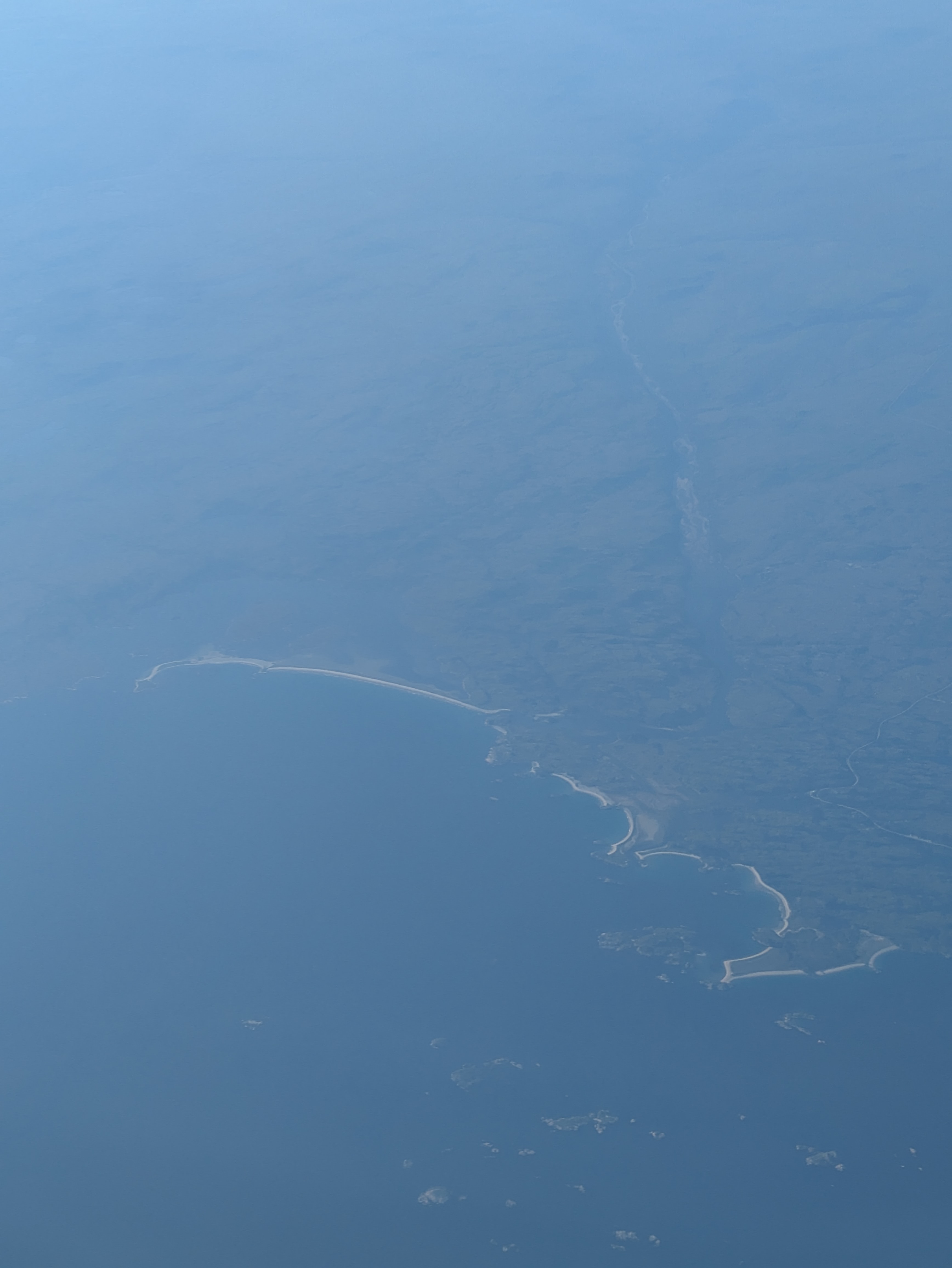
On the flight down, I was treated to some lovely views as we headed towards and over Newfoundland, including flying over the Burin Peninsula and even specifically St. Lawrence, the town where I grew up.

These are the French islands of St. Pierre and Miquelon, just off the southern tip of the Burin Peninsula.

The photos of St. Lawrence were too hazy to share (sorry!), but it was fun to fly over the whole area and recognize the places aerially.

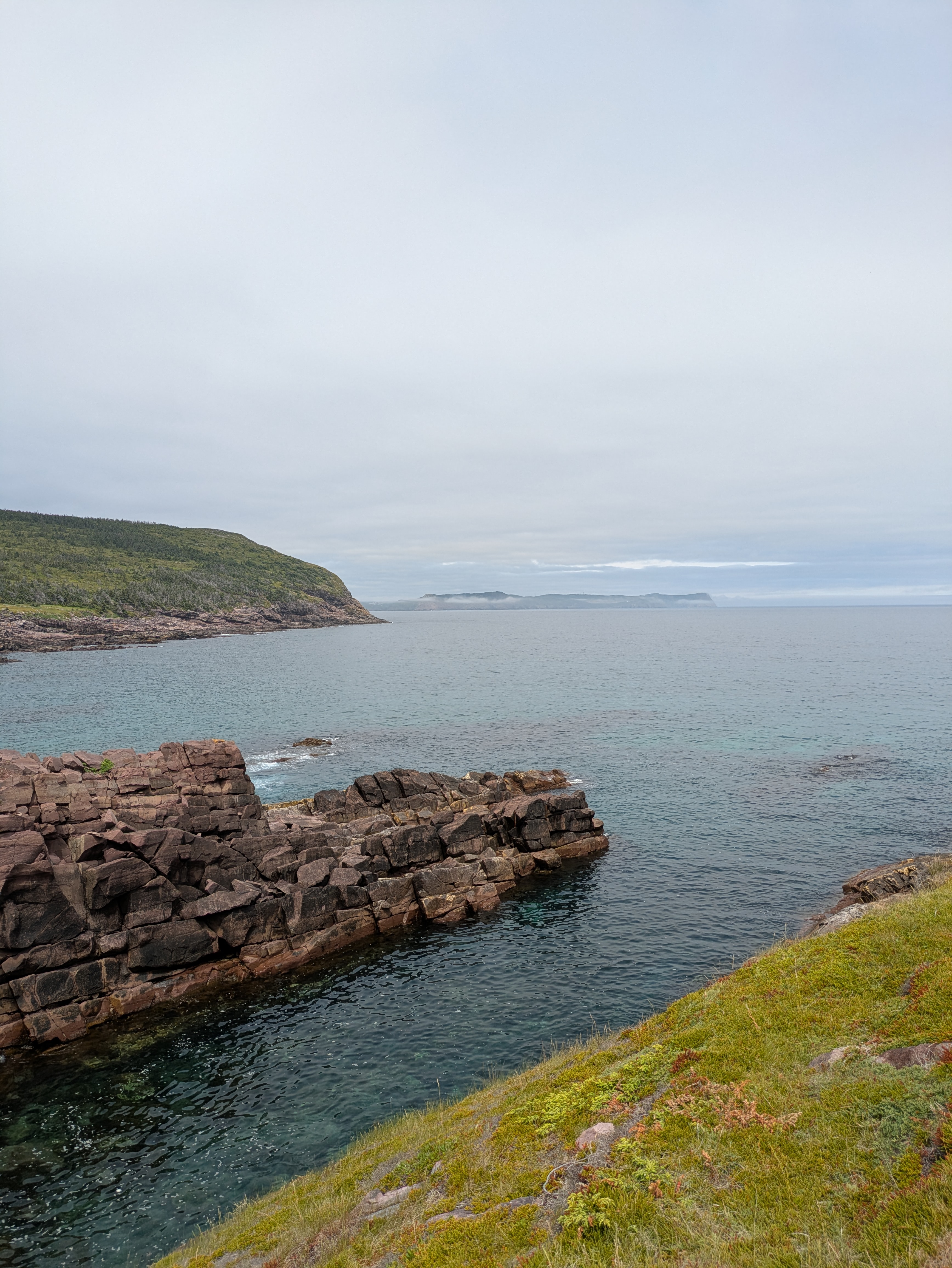
My brother, Robert, and I went for a drive one day, where I did the standard visits to Cape Spear and Signal Hill. We didn’t stop long – it was more just to get out for a drive together and those sights are always lovely to visit.

Here’s a shot of some of the shoreline near Cape Spear. The sea was uncharacteristically calm, compared to all of my other trips to Cape Spear.

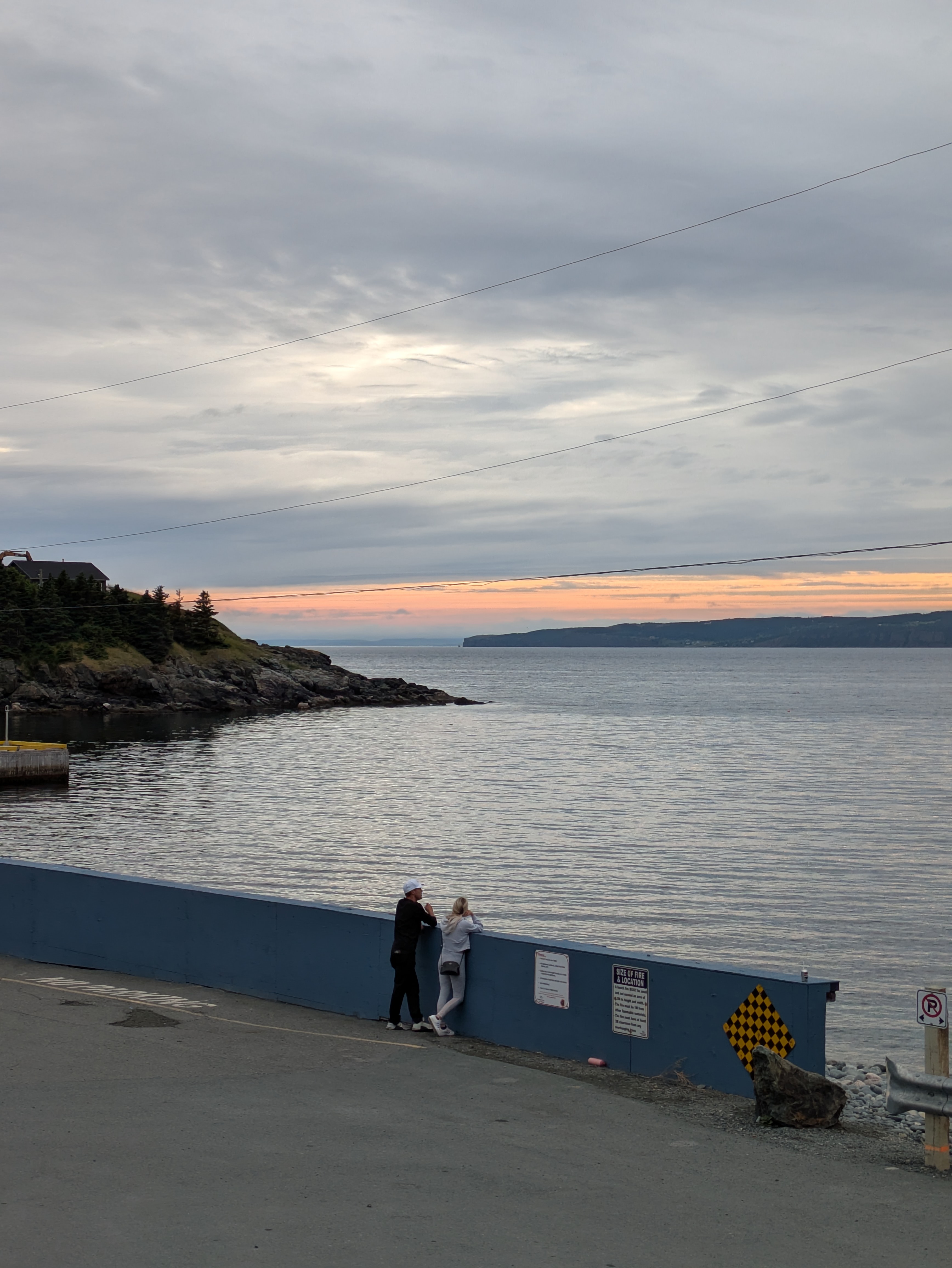
While home I made sure I got to my favourite fish-and-chips place: By the Beach. Twice. The first time was the whole enchilada – fish and chips with dressing and gravy. The second time I just had fish. I love it so much because it’s such a light, crispy batter – almost see-through! It has spoiled me for all other fish and chips.

In addition to the great fish, there’s also a great view of Conception Bay, one of the big bays of the Avalon Peninsula, on the east of Newfoundland.

It was such a lovely evening. (Again – no wind!) In the centre background is Bell Island and way in the background behind that the other (western) side of Conception Bay.

I crammed in as many visits with friends and family as I could while I was there. Most of my photos were of people and, since not everybody wants to have their faces plastered all over the Internet, I won’t post those shots here. Since you don’t know the people, it’s likely the pictures of the places you’d rather see, anyway!

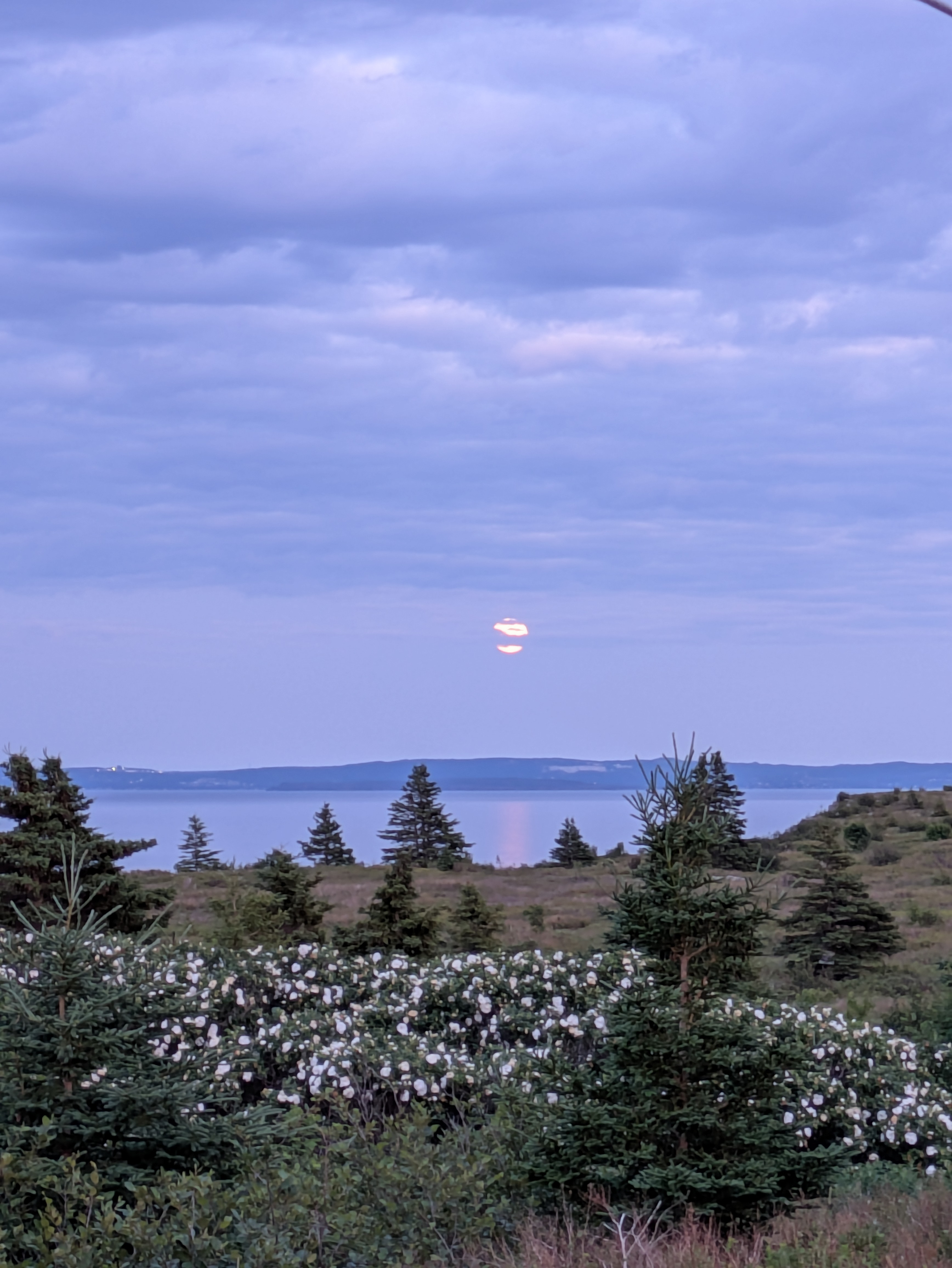
One of the places I visited was Bryant’s Cove, where my good friend of mine lives. It’s on the other side of Conception Bay, about an hour and fifteen minutes from St. John’s.

Where the picture at By the Beach was taken on the east side of Conception Bay, looking towards the west side, this picture was taken from the west side, looking east.

The moon was just spectacular that evening. And there was hardly any wind. It’s genuinely crazy how little wind there was the whole time I was home. And, for that matter, when I spent two months in NL back in 2023. Normally you practically have to wear gravity boots not to get blown around, but not any more apparently!

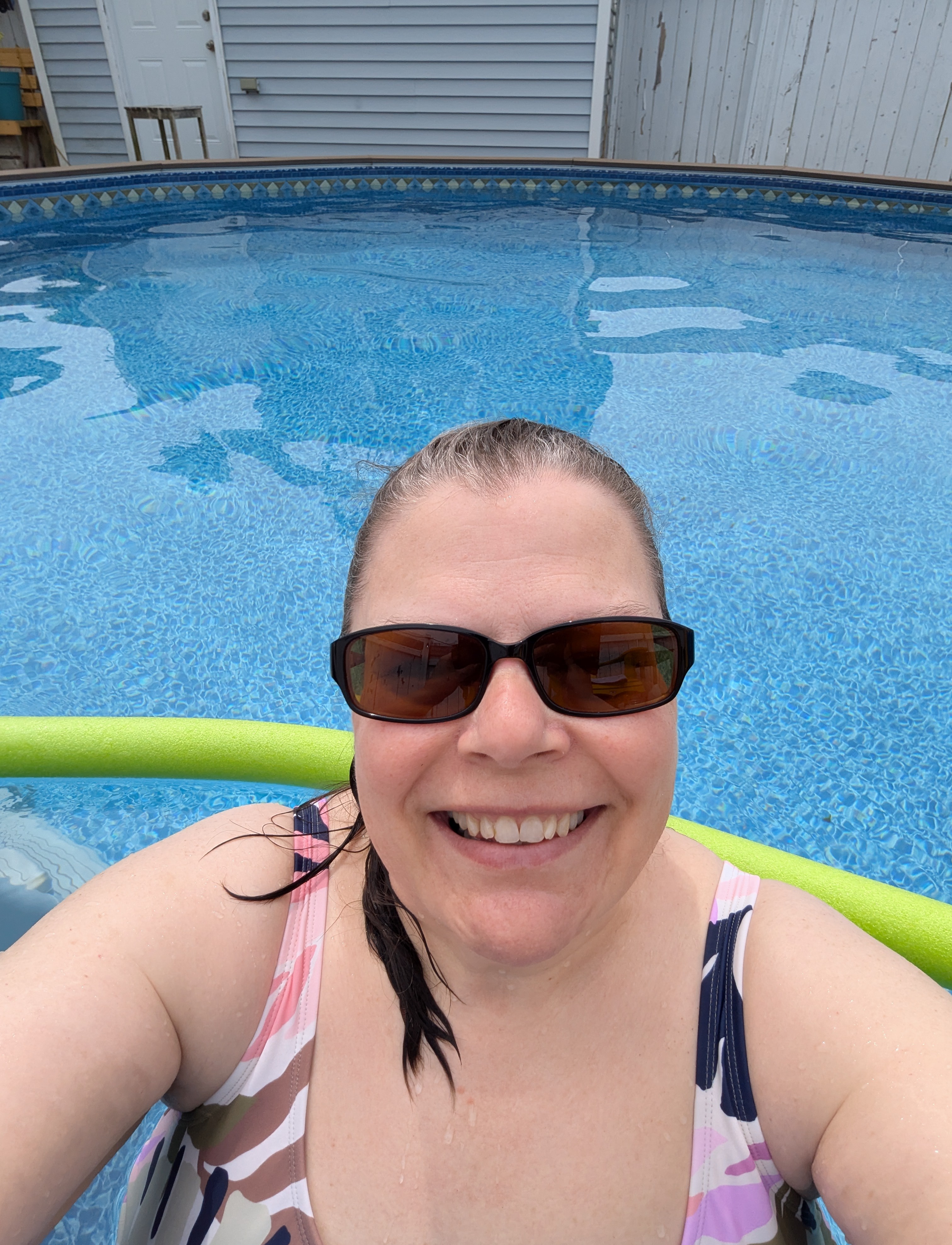
I also took advantage of the good weather and my sister-in-law’s pool while I was home. It was very relaxing and definitely therapeutic.

Me hanging out in the pool!

In addition to that, I made sure to squeeze in some crafting, too. Before I left to go to NL, I used my Cricut Joy Xtra to cut out the pieces for a sunflower project. My sister-in-law loves all things sunflower and I thought that this would be a fun project for us to work on together while I was there. It really was a lot of fun. I was surprised at how big it turned out to be! She has hung it on the front door of the house, where it looks very cheerful indeed!

(To give credit where credit is due, this project was from Jennifer Maker. I’ve linked it so you can check it out if you are interested. She has LOADS of fun projects on her site.)

It was a very busy two weeks, but they were filled with friends and family. People who have been in my life for…shoot…35 years and longer! It was balm to the soul!

It was so wonderful to see everyone. Everybody was very understanding of my slower pace and need for afternoon lie-downs and to accommodate for the pain I have now. There were only a couple of people that I would have really liked to see, but wasn’t able to, so I count that as a success, since people were the whole point of this trip.

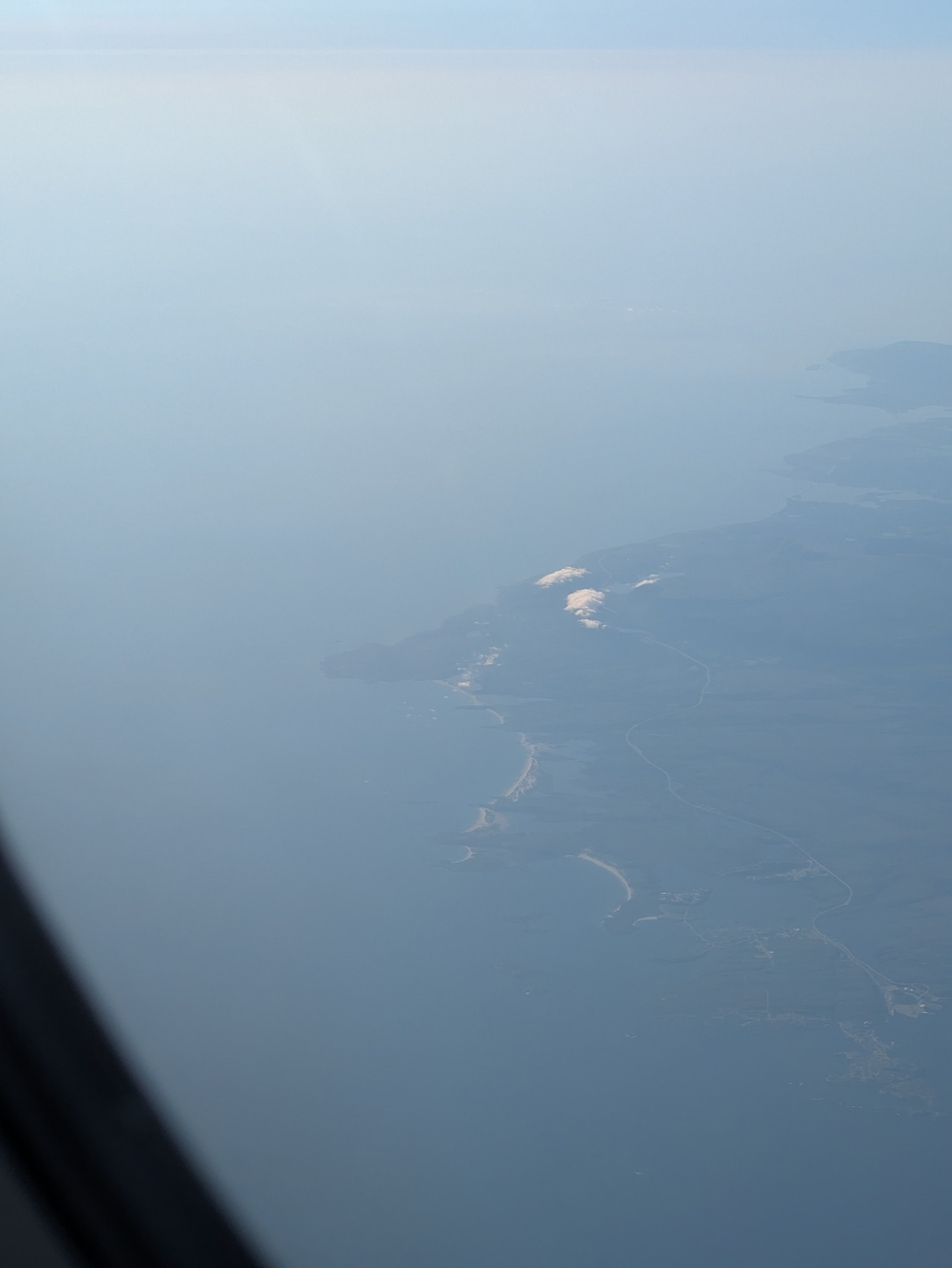
The flight leaving Newfoundland did not disappoint on the amazing views, either. Interestingly enough, we flew over the south coast of the island. I have always wanted to go there, but it’s pretty remote and out of the way, so I’ve never seen it.

Thanks to this flight, though, I was able to! The whole long stretch of it from Fortune Bay all the way over to Channel-Port-aux-Basques. It’s spectacular. There was one spot that was lined with, what looked from our height, to be beautiful, long, sandy beaches even.

Sandy beaches somewhere along the south coast
The western end of the south coast: Channel-Port-aux-Basques (bottom right) to Cape Ray (middle ground, to the left of those little clouds)

When I got back to Ottawa, I tried to line up the pictures I took with Google Maps, but it doesn’t look like Google has done much specific mapping in that area, so I couldn’t really do it. I was able to confirm the locations in the second shot, but that’s it. However, I can at least say I have seen the south coast now!

I don’t know if I’ll get back to NL again or not. But I made sure I enjoyed it while I was there. I soaked up all the goodness and love and friendship that I could.

A couple of years ago, my friend Brenda G told me about a conversation she had had with someone about taking pictures of people we care about and then they are gone. So I’ve been very intentional since then, including during this trip, to be sure to take as many pictures of the people I saw as I could.

Some of them are people who are still a regular part of my life now and some are people I haven’t seen in years. But they have all touched my life in different ways and I wanted to make sure I captured these new moments with them. I’ll be making a photo book out of the pictures, too. Not just leaving them on my phone or laptop. I want to keep them handy and close by.

Because I was very aware that this might be my last trip home, it had the potential to become a bit maudlin or even morose. But it didn’t. It for sure impacted how I looked at the trip, but I think it was in a very positive way.

You know how sometimes if you are on a trip, you might run around trying to make sure you see and do ‘everything’, but you don’t really live in the moments?

I made sure to live in the moments. I sat back and watched and listened.

It was such a joy and a blessing to see these people whom I’ve known for years and even decades talking and laughing with each other. Sharing those inside jokes and memories. Sharing challenges and frustrations, too.

I felt so blessed that I was a part of their lives and that those lives and moments will continue on after I’m gone. I didn’t have a single, solitary moment where I thought, “I wish it could continue longer for me, too.” Not one.

I realized that it is truly enough that I have had the moments I have already had with them. If I get more time with them, great. I will enjoy that, too. But if I don’t – it has been enough. My life has been enriched and made all the better for the moments we have already shared together.

I don’t mean to imply that I haven’t appreciated other times I’ve shared with them. I for sure have. This was a different perspective on it, though, somehow.

I don’t know if any of that makes any sense, but it was definitely the best gift that I came back with.

Anyway…it was a great trip. I thoroughly enjoyed it – every single moment of it!

I’d love to hear about any trips that you have had that have given you a different perspective on something in your life – please feel free to share in the comments!


If you enjoyed this post and would like to read more, don’t forget to follow!


8 Comments

A long-overdue update (My journey with cancer – Part 10)

The last few months have been a bit of a head trip and I kind of fell off the wagon of providing updates and insights on what’s going on with me and this whole cancer thing. The fatigue and brain fog are still plaguing me so writing isn’t at the top of the priority list for when I do have some energy. I think if I wait till I ‘feel like it’, I suspect I won’t be writing at all, so here we go!

It will be long – I want to bring you fully up to speed and (selfishly 😀) it’s easier to write it all in one post rather than splitting it up into multiple posts. So, get your beverage of choice and maybe a little snacky-poo, and hunker down for a big read!

Also, I won’t be doing much rereading and editing. There will likely be spelling errors and other grammatical and writing style issues. I’m definitely not vying for a Blog Post of the Year award! ha ha ha

Note: If you’ve been following along with my cancer journey, some of this post will be repetitive. At 15 months in, though, I want to do a quick recap before getting to where I am today. More details on the diagnosis and treatments, if you are interested, are found in previous posts.

Diagnosis and treatments

On February 16, 2024 I went in for a routine colonoscopy. The results from the recent fecal immunochemical test (FIT) that I had done showed blood was present, so the colonoscopy was to check things out. I wasn’t too worried.

My GP had called to let me know he wasn’t worried, either; he said that blood could show up for multiple reasons. He also assured me that if there was anything found, then we were finding it early enough to be able to address it.

Surprisingly, at that test, I found out I had rectal cancer. Biopsies were taken and there were a flurry of CT and MRI scans, along with various types of blood work. When all the results were in, it was confirmed that my cancer was stage 3, having spread to a nearby lymph node.

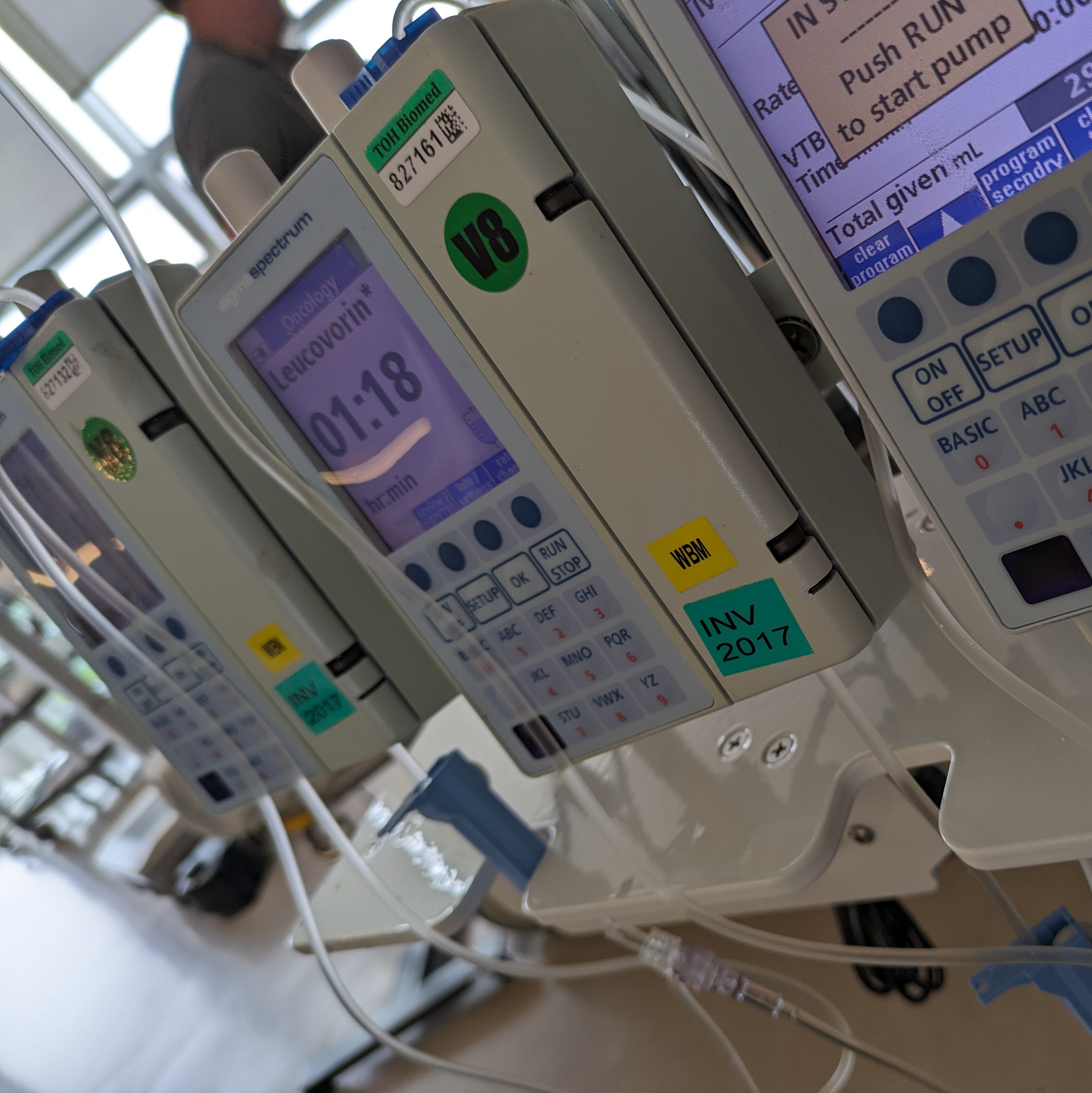
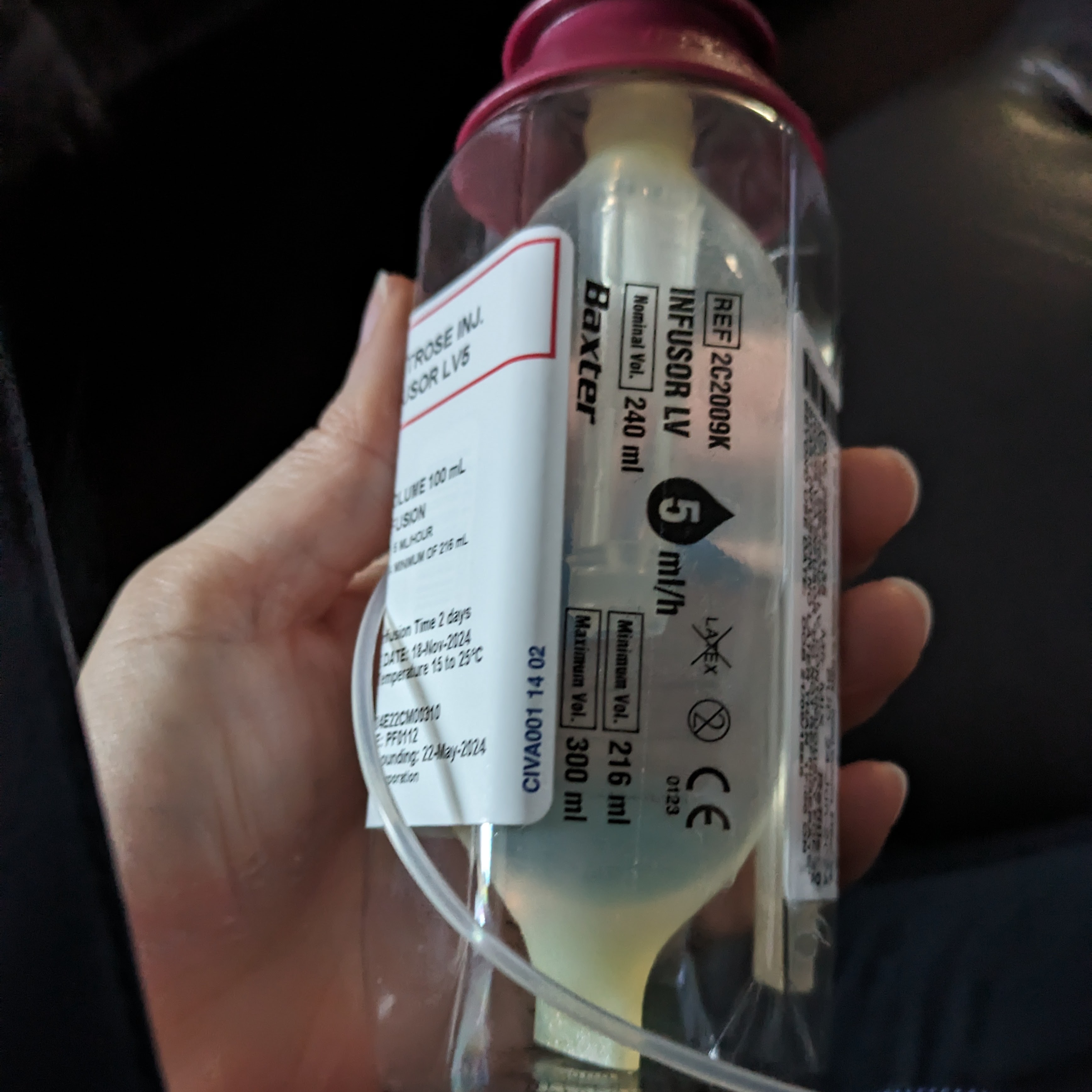
I met with a radiation oncologist, medical oncologist, and colorectal surgeons. Rather than proceeding immediately to surgery (removing the rectum and giving me a colostomy), I opted for a fairly new treatment protocol (OPRA – organ preservation in patients with rectal adenocarcinoma), where we do aggressive external beam radiation combined with chemotherapy (in the form of pills), followed by 8 cycles of pure chemotherapy administered through IV – in my case, it was a PICC line.

The 28 fractions (doses) of radiation were done from April 18 to May 28, 2024. The approximately 400 hours of chemo were done from June 24 to October 17, 2024. There were side effects from both (ranging from mild to quite painful), but they were definitely preferable to a colostomy!

Results

Towards the end of November 2024, I had a couple of CT scans, an MRI, and a sigmoidoscopy. The results from those tests (discussed in my immediately previous post) were quite positive. Things were looking up and it was a great way to go into the Christmas season.

The surgeon who did the scope wanted to do another one in January, to see what further improvement there might be, so we didn’t make any next-steps plan yet.

On January 8, 2025 I had the next sigmoidoscopy. At that test, there was a 180° turn from the last one. That surgeon advised me that I would need to prepare myself for surgery for a permanent colostomy. At that moment, the world fell out from under me.

The surgery wasn’t even presented to me as a choice. He told me I needed to prepare for surgery. It wasn’t, “When we talk in clinic, we’ll be talking about your options now, including possible surgery.” Nope. Just that I would need to have the surgery and had to start preparing for it.

Please know that he was very kind and caring as he spoke. It wasn’t a question of bedside manner at all. It was just the fact that it was an assumed done deal.

I thought to myself at the time, “I don’t think I’ll be having the surgery,” but I knew enough not to say that to him then and there. I was obviously in shock and distress, and he, rightfully, would dismiss whatever I said at that point as being due to that.

I also knew that I really needed to give myself the time to think about it. I was now at the moment where I would have to make that decision. And in that moment, lying on the gurney, I was in no way, shape, or form in the right mental state to make such a life-and-death decision. I had to give myself time.

Shock

The mental whiplash that day was crazy hard to deal with.

I had been super stressed waiting for the first post-treatment tests and then so happy in December with the initial results. Hope had been shining brightly for the future – that I would even have a future – and now it had been ripped away so unexpectedly.

After a couple of very rough days mentally, I pulled myself together and got to work doing some serious reflection.

I knew from almost the get-go of this whole experience that, even with the treatment approach I had chosen, a permanent colostomy might still be the eventual outcome. I also knew that it wouldn’t be smart to wait until decision time to start trying to learn about it and figure out how I felt about it.

To that end, I did some research on colostomies off and on throughout last year to help prepare myself (as much as such a thing is possible) for the time when I might have to make that decision. That way, with no immediate pressure to decide anything yet, I could just take my time with it and not feel rushed.

At the same time, I knew that if push came to shove and eventually I did have to make the very literal life-and-death decision to have or not have a colostomy, I might feel differently. So while I was leaning towards not doing it, I wanted to keep my mind open and leave the final decision till if and when it was necessary.

A tale of two Lucys

Once the initial shock wore off after the January 8 scope, I sat with it all. I thought about everything I had learned and really reflected on what life with a colostomy would look like for me. Most people seem “fine” with it or at least adapt to it, so maybe I could.

But what I learned was that it would be my Waterloo. It was the challenge that would do me in. I don’t know why, but I felt really strongly that it would.

I knew that while the path without the colostomy would almost certainly bring about a quicker death, I felt that the quality of life down that path would be better than it would be down the colostomy path.

I thought about both Lucys – the one I would become if I had the colostomy and the one I would become if I didn’t.

I saw the first Lucy sinking into a deep depression and I wouldn’t care about doing the work to come out of it. I saw myself in bed, with the blinds closed and the curtains drawn. I saw a very sad, dark existence where I would withdraw from everything that I enjoy in life. I would technically be alive, but certainly not living.

I saw the second Lucy eventually dealing with pain and uncertainty about the future. My physical quality of life would eventually decline, especially as the tumour regrew and depending on when/where it spread, but I felt that those were challenges that future me could better manage and cope with.

Other considerations

Do I know any of this 100%? No, of course not. But I know myself pretty well and feel pretty confident in it. Plus, this isn’t like deciding if I want to start biking everywhere rather than driving. I could try cycling for a while and, if I decided wasn’t not for me, I could simply sell the bike and go back to using my car.

This surgery isn’t like that. They cut the rectum and surrounding tissues out. They cut a hole through the skin of my belly and kind of pull the end of the colon to that hole, stitching it in place so it doesn’t slip back inside my body. That’s the hole that I would defecate though (via attached bags) going forward. They also close up the anus. (They call it a ‘Barbie bum’ – seriously. That’s what the surgeon said.)

If I had the surgery and found out that, as suspected, I really couldn’t cope with it, I couldn’t then go back and ask them to open ‘er up again. The shop would be closed. It would be a done deal.

Note: There are other options for tumours in different locations. Mine is very low in the rectum, so I don’t have the same options. Also, this isn’t a commentary on colostomies in general or people who have colostomies. It’s about my ability (or inability, as the case may be) to deal with that challenge in my life.

The decision

After looking at everything, I have decided that I will not be having the surgery.

To be completely frank, I think that regardless which option I chose, at some point the situation would get so bad that I would wish I had chosen the other.

Meaning that I fully expect there will be a point down this path I have chosen where the pain will be so bad that I will wish I had gotten the colostomy. I won’t care about the ‘other’ Lucy (who would have gotten the colostomy) and how she would feel. I will just want an escape from the pain.

When I’m riddled with pain, I’ll likely think that a colostomy life would have been grand and there wouldn’t be any problems with it. But right now, I have the clarity to see that isn’t true.

I’m not a sadist (or masochist) and at this moment, I feel do badly for that future Lucy, but this was a choice (for me) between two very bad options.

It was a very difficult decision and I have instructed friends and family not to try to convince me otherwise. I ask the same of you.

I respect that this is difficult on people who care for me and I took that into account in making my decision.

Ultimately, though, I am the one who would have to live with it day in and day out. I’m the one who has to empty the bags and clean the stoma hole. Me. By myself. Every. Single. Day. Until I die.

And there’s still no guarantee that the cancer wouldn’t come back somewhere else so it could still end up being all for naught.

So I will say here what I have said to friends and family:

You may have strong opinions and feelings about this. I get it. I truly do. I think you should find someone to talk to about it. But it can’t be me. I can’t manage your challenges with this on top of my own. I can’t – and won’t – take that on.

Telling the doctors

I talked to the surgeons and my oncologists at the end of January and they were all, as I expected, surprised with my decision. I knew that I was going to need to get them to understand that this was not a panicked, fear-filled decision, so that was my focus in those appointments.

I needed them to know that I had done the research and that I had thought it through calmly and with a lot of reflection. I am not under any illusions that there will be a magic cure – I know that what will come will not be pleasant. And, at the same time, I am perfectly calm and at peace with the decision. It is for sure the right decision for me.

I won’t go into details about each of the conversations. That could be a whole book. I will just say they were worried about me and wanted to make sure that I understood what I was choosing by opting to not have the surgery. I felt well-cared for.

My radiation oncologist, who is the person I’ve seen the most often, even said that my decision was difficult for him not just because I am his patient, but, because he has gotten to know me over the past year or so, he has come to like me as a person, too. That was genuinely lovely to hear.

It is so helpful, as a patient, when you know that your care team genuinely cares about you as more than just a disease that needs to be treated.

And now?

They did another scope in March, from which biopsies were taken, and it was confirmed 100% that cancer cells were still present. It closed the door on that little bit of hope, but it definitely wasn’t a shock.

The medical oncologist also had biomarker testing done as it may be helpful in determining if there are any targeted therapies that might help as things move along. That is super cool. I have learned which gene has mutated to cause my cancer as well as what specific mutation has happened! It’s amazing what they are able to do these days.

The surgical folks have tapped out of my care since I’m not having surgery. They won’t be scheduling any more sigmoidoscopies, but my radiation or medical oncologist can request them if we want to have a peek inside to see exactly what’s happening at the tumour site, which I will for sure want at some point.

I will be having a couple of CT scans and an MRI again next month to see what shows up there and to see if there is any indication that it may have already spread. Those results will be the new baseline going forward.

My treatment options

There aren’t actually any treatment options right now. I saw the doctors again in April and this time I had a lot of questions for them.

From the radiation oncologist:

  • I had the maximum amount of pelvic radiation last year. If I were to have more full-dose radiation in that area, it would likely cause a breakdown or even necrosis in the tissues, including organs, in that area of my body. Not much point of slowing the tumour down if all the tissues and organs die!
  • At some point, though, low-dose pelvic radiation may be appropriate. There would still be the same risks, but lower (because it would be lower doses) and it wouldn’t be done until/unless the benefits at the time outweigh those risks.
  • If the cancer spreads outside the pelvic area, full-dose radiation might be an option for that. The two most common areas that rectal cancer spreads are the lungs and the liver. If it spreads to the lungs, which are in the thoracic cavity, not the pelvic region, full-dose would probably be appropriate. But the liver, which is in the abdominal cavity, might still have been affected by the pelvic radiation, so we’d have to see.

From the medical (chemo) oncologist:

  • For the medical (drugs) side of things, it’s a matter of waiting for the right timing.
  • My oncologist explained that there would be no benefit to doing more chemo right now. The cells aren’t growing quickly so there isn’t anything, really, to slow down. I’d just end up kicking in all the chemo side effects with no real benefit.
  • Once we get to a point where the benefits of chemo would be worth the side effects of it, we will look at the options then – whether it would be a regular chemo-type treatment or a possible targeted therapy.

If you are wondering what a targeted therapy is, here’s the Cole’s Notes version. This is based on my understanding of what little I’ve read and only related to my own situation, so don’t run to the bank on any of this! My poor ol’ grey matter ain’t what she used to be, so take it all with a grain (or truckload) of salt.

Where chemotherapy affects the whole body, affecting healthy cells as well as the cancer cells, targeted therapies have been designed to only affect the cancer. From what I understand, they are ‘targeted’ to the gene itself, and even the specific mutation of that gene.

Prognosis

The doctors can’t really say with any amount of certainty how much time I have. The last surgeon I spoke to (in April) said she figures less than a year. But the others don’t think it will be that quick. They don’t think I have years and years, either, but exactly how long? Who knows.

The only thing we know right now is that there are cancer cells at the original tumour site. If it spreads outside that area, where it goes will have a huge impact on ultimate prognosis.

Barring divine intervention or medical miracles, I’m operating on a 1-3 years perspective. I need to get all my ducks in a row in case it turns out to be less than a year. (Even though that doesn’t seem likely, I want to have everything ready.) Anything I get beyond 3 years will be gravy. 😊

Side effects and such

Right now I still have heavy brain fog and a lot of fatigue. That’s a big reason why I haven’t written in quite a while. It takes a lot longer to do things and I’m just too tired. I am doing a course to help with the brain fog that is put on by this great organization called Wellspring. (If you have or know someone who has cancer, have them check it out. They have a lot of great resources.)

I still have chemo-induced peripheral neuropathy in my hands and feet, but it has really improved in my hands and has just started (this week) showing some signs of improvement in my feet. Things aren’t as painful as they were from that, which is great.

I also, since December, have been having trouble with my hips. They have really tightened up, which is common from the radiation treatment. I didn’t attribute it to radiation at first, because it had finished about 7 months before I started feeling it, but it usually starts within a year after radiation and can even be delayed in showing up longer than that.

I’ve been seeing a physiotherapist who specializes in cancer patients and she has given me some stretches and exercises to help with it. When I stand up from sitting, it’s like I’ve turned into a 90-year-old. Nothing wrong with being 90 – unless you’re only 55. ha ha ha

I’m still losing weight, so I have to keep an eye on that. There’s no big risk – I still have plenty to lose – but if it happens too quickly, it could be a sign that something’s not right. Well, something else isn’t right. 😁 I need to make sure I’m eating balanced meals to get the nutrition my body needs for everything that’s currently going on and what’s to come.

I’m also still talking to the oncology social worker on a pretty regular basis, in a counsellor capacity. That has helped throughout this process in dealing with the mental side of things. She recommended a little while ago that I talk to my GP about an antidepressant to help even things out. I did and, while the drug makes me groggy in the morning, it has helped keep me on an even keel, which is great!

I am having some discomfort in the rectal region. I expect it’s the ulcerated tissue. It’s not really painful, mostly just uncomfortable. One of the oncologists explained that eventually it gets too painful for a lot of people to sit up and they end up in bed a lot of the time. I’m definitely not there! (I’ve ordered a recliner that I’m hoping will help me avoid that, though, or at least delay it as long as possible.)

How I’m feeling about it all

Once the initial shock of everything wore of in January, I was fine. I realized, in fact, that my biggest stress or worry wasn’t the fact that I’m now likely to die a sooner, more painful death, but rather it was about having to get people to accept my decision and dealing with that.

I’m honestly fine with it. As I said to my social worker when we talked a couple of weeks ago, I don’t see this as being any better or worse a time to get this news than some point in the future.

I don’t have a death wish, by any stretch. I enjoy my life. And, if I have decent health, I see me still enjoying it as much in 5, 10, or 20 years from now.

But I don’t expect anything momentously different happening over the course of time – I don’t have kids or grandkids that I want to see grow, marry, become successful, etc. and I’m definitely not on the cusp of any humanity-saving discoveries (or any discoveries at all ha ha ha) that I want to stick around to complete.

All that to say I don’t think I’ll be missing out on anything by this happening now.

So whether I die in 2 years or 20, I expect I’ll be enjoying my life and I’ll still not want to die. I won’t feel any better about it then than I do now.

What’s next

My focus right now is to get my brain in shape to return back to work. At least part time for a while. Between the brain fog and the fatigue, I’m not much good to anybody right now. I can’t process much information or do anything with what I can process. I’d be stealing a paycheque and getting in the way.

I don’t drive much any more because I don’t trust myself with it because of the fatigue. I’m trying to be more active, doing more walking.

I do some crafting to help keep busy when I can. Mostly I am making appointment card folders for the radiation clinic and, now that my fingers have started to feel better, I’m also making cards to bring there for the patients, too. Doing stuff for other people is a good way to feel better about your own situation!

I’d like to do some genealogy, but it’s too much right now.

There we have it!

Now you are up-to-date!

Please know that I am happy. I am at peace. There will be times when I’m struggling with the existentiality of it all, but not at the moment.

Thinking of getting back to work helps me think a bit more long-term, which is something I haven’t been able to do since February 16 last year.

I continue to learn about myself and I am so grateful for that. I have way more things in my life to be grateful for than not.

There are people who live into their 80s and 90s who don’t feel the joy and gratitude in their lives that I feel in and for my life, right at this very moment, even given what’s ahead.

How can I be sad about that?


If you enjoyed this post and would like to read more, don’t forget to follow!


1 Comment

The waiting is partly done! (My journey with cancer – Part 9)

If you read the previous post, you know what a big deal last week was – getting the results of how well my cancer treatments did in addressing the tumour situation. A few of you asked for another post to provide an update when I had some answers so here you go!

I will start by telling you that I don’t have all of the answers yet. I was supposed to have an appointment with the Ottawa Colorectal Group last Thursday (the surgeons who are part of my care team), where I think all the details about results and such were to have been discussed, but that has been postponed.

The surgeon who did the sigmoidoscopy on Wednesday wants to do another scope in a few weeks before I meet with them in-clinic to discuss everything.

Now – on to what we did learn!

Results so far

The MRI results were the first to come in and provided the first indication that things were definitely moving in the right direction. It was, naturally, in a lot of medical language, but I was able to glean some key bits:

  • The lymph node that had previously been affected is clearly “no longer suspicious”.
  • The area where the tumour was appears to now be scar tissue. Obviously that’s a little vague, but “scar” is better than “tumour” any day of the week and twice on Sundays!

The CT results didn’t provide any more details, but the sigmoidoscopy was quite helpful.

It’s a very short procedure (the scope itself was maybe about 3 minutes), so I didn’t have any sedation or anything. As a result I was able to watch the whole thing. It was super cool to be able to literally see it!

Where at the colonoscopy in February there was a lumpy-bumpy, ugly blob of a tumour there was now a beautiful white section of scar tissue. Yes…beautiful (all things being relative)! It was so nice to see!

Dr. Zhang said that from what she could see, it exhibited a “near complete response” to treatment. She explained that the body continues to respond to treatment for up to 12 weeks after treatment ends and that’s why she wants to do another scope in a few weeks. It’s possible that we will end up with a “complete response” by that point, which would be the best possible result.

Also, the mystery of the ever-present blood I’ve been having the last 4 weeks was answered. The area around the scar tissue is very actively bleeding. As quickly as Dr. Zhang washed it away (with a thingy like they have at the dentist’s office), the blood filled out again. But she said that was normal and nothing to worry about, so I’ve scratched that off the “Things I’m concerned about list”, which is great.

How I feel about it

In keeping with my standard approach, I’m not putting all my eggs in the best-case basket, but I am hopeful that’s where we’ll end up. Even if that’s not the end result, things are still very, very positive and I’m quite content with that right now.

Yes, there are still a lot of questions unanswered, but what I have learned is enough to tide me over till January.

Where you can see pictures, if you want

Several photos from the scope last week have been uploaded to my online medical chart, which is awesome. I took a couple of pictures myself, but the ones they uploaded were a lot clearer.

I also reached out to the clinic where the colonoscopy was done in February and they were able to send me some photos from that scope, including of the tumour! I had wanted to ask that day if I could take a picture of the screen showing the tumour, but thought they’d think it was too weird. I’ve obviously gotten over that. 😀

I know that might sound a bit strange, but in addition to being (obviously) personally invested in this whole thing, I am also very intellectually curious about it. so being able to physically see it is really cool to me. It is particularly interesting to be able to have the before and after comparison photos.

I was tempted to add a couple here, but I know some people are very squidgy about that kind of stuff so I haven’t.

Instead, I’ve posted them to another blog that I have, which is normally just used to help me learn blogging skills. I’ve put them there in case any of you are also curious to see the comparison.

In a nutshell

Well, there you have it! Treatments have worked – not completely yet, but well enough to be happy. There’s still a long road ahead, but we know it will be a much nicer road than the worst-case-scenario road, so yay!

Keep sending all your positive thoughts/prayers/vibes/etc. They really do help and, like I said, we are nowhere near the finish line yet!


If you enjoyed this post and would like to read more, don’t forget to follow!


7 Comments

Coping with cancer: The waiting game (My journey with cancer – Part 8)

Big emotions before some big news

As you may know, I was diagnosed with rectal cancer in February of this year. Due to metastasis to a nearby lymph node it was assessed as stage 3. I did 28 radiation treatments between April 18 and May 28. I started bi-weekly chemo treatments on June 24, ending October 17, for a total of about 400 hours of chemo.

Since October 24, when the chemo-related Grastofil injections ended, I have been in a bit of a state of limbo waiting to find out how well those treatments worked – or not.

This is the week I will find all that out. By Thursday I will know.

So this is a pretty emotional week. It’s been an emotional few weeks leading up to it, to be honest. I even hesitated about writing this post because of all of the emotions going on right now.

Before we get into the meat of things, and you get all worried, let me assure you that while things are pretty heavy right now, they are not always that way.

I’m generally a pretty happy and positive person, even throughout the quagmire that cancer treatments can be. I love to laugh and have fun. At the same time, cancer is some serious shiznit and it’s not always possible to be in a bluebirds-and-rainbows state of mind these days. Shoot…even in regular, every day life, being perpetually happy is not very realistic.

Not to say that I’m in a negative state of mind right now, but I am feeling a lot of things and it really does feel quite heavy.

Helping you help me

If you feel like you want to add a comment or send a text or email to say something supportive, that would be lovely! If you aren’t sure what to say (which is normal), let me help you with that!

The kind of thing I have learned that helps me most is along the lines of “That sucks…that’s a lot to deal with…I wish you didn’t have to go through all this…etc.” It might go against your instincts, but it really does help. 🙂

It turns out that the normal positive platitudes that we all tend to lean towards, such as “You can beat this! You’ll do great! Everything will be fine!”, don’t actually help me. They make me feel worse.

I respect, though, that those types of sayings may be helpful to other folks, so I’m not saying that they aren’t ever appropriate in these situations. Personal journeys are just that – personal and therefore individual so what works for one doesn’t necessarily work for another.

There…That’s done…on we go!

The waiting phase

As I said, I fully completed all my scheduled treatments on October 24 (the end of the Grastofil injections). Since then I’ve been in this waiting-for-results phase.

Annnnnnnnnnnnd…I have learned I am not great at waiting. I was great at the doing – it wasn’t fun and, in different ways and at different times, it was quite difficult and painful, but because I was “doing”, I was mostly OK – not too stressed out, at any rate. I had things to do and side effects to deal with, so I was distracted enough not to be thinking about what would come next. But this whole “nothing left to do but to wait” business is definitely not my forté.

I actually started to feel the stress and pressure of this waiting period two or three weeks before chemo ended. I knew I would need some help navigating this stage so I set up an appointment with my oncology social worker, who had been helpful in earlier stages, before the stress became too heavy.

I keep saying that it’s the waiting phase that is stressing me out. But really, it’s what’s at the end of the waiting that is truly stressful: the results.

These results will tell me if everything worked or if it didn’t and what that means now:

  • Will surgery be required?
  • If so, what are the options?
  • Will a permanent colostomy be required?
  • What’s my overall prognosis?
  • Am I likely to be part of the 75% of those who do this treatment protocol and get to live another 5 years – or (dare to dream) even longer?
  • Or will I be part of the other 25%?

Either way, the emotions come, sometimes one at a time and sometimes in a jumble, and they are all big: hope, fear, worry, gratitude, despair, loneliness, joy…you name it! There’s a big ol’ pot of emotion soup running through my brain and body right now. I feel scared and even terrified one minute and then flip to hopeful and grateful two minutes later before flopping back to scared again. How I haven’t stroked out yet is beyond me!

I’ve been reading Eckhart Tollë’s The Power of Now, but I am definitely not at a point where I can just impassively and neutrally watch emotions come and go. I’m on the roller coaster of emotions more that I probably have ever been in my whole life.

Suffice to say…It’s a lot.

My anchor: Realism combined with hope

In case you don’t know me, I’m not usually one to intentionally borrow trouble. Sufficient is the day and all that. However, these are genuinely huge life impacting questions, so it’s tough to completely avoid thinking about them and what it could all mean for my future. Consequently, it’s very difficult to keep the emotions in check and stable, too.

As with everything else in this journey, I’m not trying to be either optimistic or pessimistic. Instead, I’m shooting for a balanced realism. It is possible that the radiation/chemo got rid of the cancer and it is also possible that they didn’t.

If they did – great! It will still mean very close monitoring (every 2 to 3 months) for the next few years, but it will have bought me some time. If not – well, my day-to-day life will very likely change drastically. Both of those options are very possible outcomes this week.

I am hopeful that it’s the best-case scenario and at the same time, I’m also trying to prepare myself for other alternatives.

How I am coping with it

I have already written a few posts on how I cope with the mental challenges so I won’t go into all those details again here. To give you easy access to potentially helpful ideas, I will link those previous posts below. Here I will just share some things that come to mind now.

As I’ve said in previous posts, I really work to not let the periods of fear, anxiety, and sadness take up permanent residence inside my head. I know from my experiences with depression and anxiety that those two would happily become forever roommates, without even the decency of paying rent, so I consciously work to keep from falling into that kind of cycle.

The further into it you fall, the harder it is to get out, so while I allow myself a certain amount of time to feel what I feel, I also don’t let myself stay in it for too long.

To get out of it, I frequently give myself a task that needs to be done – laundry, organizing a closet, working on a craft, etc. – to get myself out of my head and distracted from those emotions. Watching TV has even helped! The Derry Girls (Netflix) and The Taskmaster (YouTube) have dragged me out of so many moments of sadness with full-on uproarious laughter that I can’t count them. Laughter really does help.

Keeping in touch with the social worker has also been helpful. I can be totally frank with her. She’s an objective third party so I don’t have to worry about worrying her, like I do with friends and family. As a professional, she also has different ideas for coping with things than those in my personal circle would have, which has been very helpful.

Another big help is my personal village of supportive people, as the example below shows. I have also learned how important it is to recognize what I need and to let people know what those needs are, such as earlier when I let you know what type of written or verbal encouragement is most helpful to me, as well as what doesn’t help. Thankfully, because my village of supportive folks is amazing, people have been very receptive and respectful of that.

The gift of a few short words

As an example, my sister-in-law, Mariette, asked me on Monday how I was feeling about the upcoming appointment, if I was worried. I hesitated and finally said yes, I was.

I explained that I probably wouldn’t be as worried if not for the presence of blood every day for the past 4 weeks, which is generally not a good sign, but I’ve let the doctors and nurses know, which is all I can do about that right now. I’m trying not to make a big deal out of it, but that said, I am still worried.

Then she said, “That’s understandable. It’s a big thing.”

If I could have crawled through the phone to hug her at that moment, I would have. That was one of the kindest, sweetest things anybody could have said to me at that moment.

Her simple statements told me, “You are safe in telling me how you really feel. I know this is a very difficult time for you and that you are struggling. These are serious issues you are dealing with, and it’s OK for you to be worried. In fact, it’s natural for you to be worried. I am here for you.”

Her acknowledging the legitimacy of how I felt made me feel stronger and more positive, whereas had she tried something more overtly positive, from the cliché universe, it would have made me feel worse.

I am very grateful to have her as part of my village.

It’s OK to be worried

And she was right. It’s OK that I am worried. I don’t know what the next few days will bring and what decisions I will need to make.

It’s also OK if you are worried for me. I’m the one with cancer, but if you are in my circle, you are going through your own experience with this, too. I hope you have someone in your life to whom you can turn with your concerns and worries about it.

It’s important to be able to talk about it – to just kind of vomit it all out there. Probably not to me, though… To be honest, I don’t know that I’m strong enough to carry me and you through it. I’d probably be fairly useless. But I do know it’s hard on more people than just me. It sucks for you, too. It’s hard to see someone you care about go through something like this.

An imaginary holiday and a life lesson

If I had my druthers, we wouldn’t have to deal with it. Maybe we’d be on a holiday instead. One where a shredded immune system and peripheral neuropathy and tests and scopes and scans are completely unheard of and unnecessary. One where we sit back and relax, enjoying good food, beautiful views, and great company. And lots of laughter.

Maybe one of us forgets to pack the printed tickets for a remote excursion we were looking forward to. There’s no wi-fi and, with no way to access the digital tickets, there’s no excursion for us! Not to be completely thwarted in our wont for adventure, though, we laugh it off and make up our own itinerary for the day – discovering paths and places we never would have if not for the tickets snafu.

Not unlike reality, really. Life often takes us off the paths we have planned and, depending on the attitude we choose to bring to them, those new paths provide experiences, learning, and growth that couldn’t have come any other way.

I assure you cancer was not a path I had on my planned life itinerary. I’ve learned things these past months, though, that I never would or could have otherwise. I’m not glad I have cancer, but I am grateful for the learning and growth I have experienced as a result.

So, while I am worried about what this week will bring, at the same time, I know that whatever unexpected path I end up on, there will be opportunities for more growth and learning there, too. In fact, a part of me is even curious as to how I will meet those challenges, as well as the growth and change I will experience as a result, strange as that may be.

Documenting the moment as we live it

The fact that I know change is on the horizon is one of the reasons I really felt the need to write now – before the waiting ends and before I know whatever it is that is waiting to be known.

Weird as it may sound, I wanted to write about this time with my “while waiting” eyes, rather than with retrospective eyes, which always add different nuances to memories. It wouldn’t be as authentic. And, ultimately, at the end of whatever comes next, I won’t be the same so, I suppose, I wanted to document and give space to the current me.

Does that make any sense? Do you ever feel that way? Something momentous is about to happen and you wonder how you’ll deal with it or where it will take you, conscious that you won’t be the same as a result of it? Maybe it’s just me on a weird tangent. 😀

Sharing what you have learned

Since there is no one approach for support or dealing with life’s challenges, I’d love to hear about your experiences – things that have helped you along your various paths and journeys in life.

  • What types of support approaches have helped you?
  • How have you let people know what you needed? How was that received?
  • How did you prepare to face the unknown?

Please feel free to share your thoughts and experiences in the comments – we can all learn from and help each other!

NOTE: This doesn’t just have to relate to cancer or even just to health issues in general. Things you have learned from other life challenges could be helpful, too. 🙂

More info on mental health struggles

As I mentioned earlier, here are the links to some previous posts where I talked about the mental health challenges I have gone through and things that have helped me. Feel free to share in the comments any resources (websites, reading, etc.) that you have found particularly helpful, too.

Thank you for taking the time to read along and for sharing any of your experiences. I really appreciate it. Building a supportive community, even an online one, can be really helpful. It takes a village to do more than raise a child!

Lucy


If you enjoyed this post and would like to read more, don’t forget to follow!


3 Comments

How I cope: My journey with cancer (Part 7)

As I mentioned several times in my previous cancer-journey posts, I have had some big mental struggles since my diagnosis in February 2024. It’s been a serious head trip, to say the least. However, I’m not going to talk specifically about those challenges in this post as I’ve talked about some of them in other posts – feel free to check them out here: Cancer journey.

What I want to focus on today are the strategies I use to help me deal with those struggles. This is long, so buckle up!

Caveat: I’m not an expert

Before I do, I need to state that this post is based on my own personal experience. It is not medical advice or expert advice in any way, shape or form. If you are struggling with mental health challenges of any sort it is really important that you talk to someone in a professional capacity to help guide you towards the things that might help you.

Have a strategies tool box at the ready

I have had issues with depression and anxiety in varying degrees pretty much throughout my life. I didn’t always know that was the case – I just thought that was the way everybody felt. In my early 30s I learned I had depression and in my 40s I learned I had anxiety.

Over the years, I have talked to therapists and counsellors and read books to supplement what I learned from those sessions.

All of that allowed me to develop a tool box of strategies that I can dip into when I feel myself slipping towards depression or a bout of anxiety coming on.

Recognize the signs

The very first thing that was helpful was simply being able to recognize the potential mental damage that this could do to me. I was diagnosed on a Friday and I was in bed almost all day that Saturday and Sunday. I was in a spin and I spent a lot of time crying.

Somewhere in there, I had a little chat with myself because I knew there was a very real danger of slipping into a very deep depression. Having had experience with that in the past, I knew I did not want to go there again. On top of that, I knew that being in a depression would not at all be helpful in dealing with the cancer. Depression doesn’t want to deal with anything, so it had to go.

I told myself that I could have the two days to be sad and grieve – to feel all the feels and so on – but then I had to pull it together and start to figure out the next steps.

That wouldn’t have been possible had I not had my previous experiences and been able to recognize the signs of depression and know the possible dangers associated with it.

Balance feeling the feels with not slipping into depression

At the same time, I also knew that it’s also dangerous to ignore what you are feeling.

I found myself placed in a very serious situation – a completely and totally life-altering (and potentially life-ending) situation. Of course I was going to have big feelings! It’s natural. As such, it’s important not to ignore those feelings and try to pretend they aren’t there. When we do that, they will still eventually come to the surface and usually in ways that we have no control over.

Right from the get-go, then, I decided that I needed to be sure to allow myself time occasionally to have days where I can be sad and afraid and whatever else it was that I would feel as going through this whole journey.

When I feel the strong emotions coming up, I give myself permission to give in to them – usually just for a few hours and sometimes for a day. It’s like a pressure valve that you need to open up every now and then to keep things at a healthy level.

I have found it really helpful, both in allowing myself the opportunity to feel and express those emotions, and in having the limitation put on it to keep it at a healthy level.

Call out the little monster’s messages

A third tool that I pulled out is recognizing the negative messaging in my brain for what it is – untrue and based in brain chemicals, not reality. I attribute that messaging to a fictional little cartoon monster living in my head.

One common message I have had is that I shouldn’t be having these struggles mentally. Early on, I had thought a lot about all the people I’ve known over the years who have dealt with cancer or other huge health issues to see what I could pull from their experiences that might help me.

Unfortunately, as I went through the ol’ mental Rolodex, I realized that not one of them had ever talked about their mental struggles with it. They would talk about some of the physical stuff, but not the mental. Instead of helping me, it left me feeling even worse. If nobody else had any mental struggles with this, why did I?

Of course, the little monster loved that train of thought. He fed off of that for quite a while and even now still occasionally has the brash nerve to pop his head up to try to convince me that I am somehow less-than because I have been struggling so much with this.

But because of my previous experiences, I was able to recognize the voice of that little monster and his messaging. In doing that, I was (and am) able to counter those messages. When I recognize them, I apply logic to them. I look for the proof.

For the message about me somehow being “less than” because it seemed that nobody else had the mental struggles that I had, I did research on cancer and mental health. You won’t be surprised to learn that there is loads of information supporting the fact that mental health issues (in varying degrees) are very common for people diagnosed with cancer.

That proof quashed the little monster’s voice. What I’m feeling is normal. The reality is that people probably just don’t feel comfortable sharing those struggles.

He still pops up every now and then, but I apply the same technique of looking for the proof and off he runs back to his little corner somewhere.

Talk about it

Both cancer and mental health challenges are still a little bit in the closet. They are often still treated like a dirty little secret. Many people are still immediately uncomfortable when they hear someone talk about either of them. Combine the two together and it’s a real mess.

That’s one reason why I have been vocal about it. As mentioned above, part of my mental health struggle was feeling isolated in having mental struggles with this. I talk about it in part to make sure that if someone else has to go through this, they will have at least one person they know who has struggled mentally with this and hopefully they won’t feel alone in that regard.

Another reason why I talk about it so openly is to hopefully reduce the awkwardness around talking about it. People shouldn’t feel uncomfortable because someone has cancer or mental health struggles. One day, I’d like it to be as easy to talk about as the flu, a broken finger or any number of other things that are totally easy to about.

Also, on a selfish level, I talk about it because I need to, for myself. I need to be able to talk about what I’m dealing with, how I’m feeling, and so on. It’s not healthy to keep all this big stuff in and to yourself.

Figure out who you can talk to about it

Part of talking about it means figuring out who I can talk to frankly about it and who I can’t. There are some people with whom I can go to the potentially dark places with, making jokes and what-not, but most people aren’t able to handle that so I don’t go there with them.

Only a few people know, for example, that I’ve already had photos taken for my obituary and memorial service. Early in the summer, I figured that since I might lose my hair, I should get the photos done before chemo started. For me, it was simply a practical decision. It was no different than making sure my will was updated and getting the health and financial powers of attorney done. For others, though, it’s “morbid” and they don’t want to go there.

You will likely find the same thing. It’s OK that not everybody will be on the list of folks you can talk to. That’s not about you – it’s about them. So don’t take that on for yourself. Identify and talk to the ones you can talk to.

If you don’t have anyone in your personal circle you can really talk to, there are support groups that you can join – online and in-person. Check out cancerconnection.ca for some information about that.

Set boundaries

Early on, I set my boundaries with people. I explained that my approach isn’t to keep everything positive. This is not a bluebirds and rainbows situation. My approach has been one of practicalities, with what I call a realistic positivism.

I hope this works out to be the best-case scenario. And at the same time, I know that it might be the worst-case scenario. Pretending that it could only have a positive outcome isn’t helpful to me. I have to acknowledge the potential negatives of this because there are practical things that need to be dealt with. It also doesn’t work for me mentally to pretend that everything is bluebirds and rainbows. In my conversations with the nurses and doctors, I tell them I want the good, the bad and the ugly. That way I can set realistic expectations and be better prepared to handle what comes.

I let people know this right out the gate. I even told them if they don’t know what to say, they can just say, “This really sucks. I’m sorry you have to go through it.” That’s all. No grand, eloquent philosophical statements. Just reality cuz it does suck and I do have to go through it.

I also did some research and provided them with links to info that might help them because even though I’m the one with cancer, it’s also tough for people who have a friend or family member with cancer. I wanted to make it as easy as possible for them to get info they might need on their own journey with this.

At the same time, I was clear that I wasn’t going to be able to hand-hold them the whole way. I need to focus on my own health and needs. I try to be respectful of where they are and what they might be going through with this, but ultimately it’s not my responsibility to help them through it. My focus has to be on me right now.

Make communicating updates easy on yourself

Within the first week after being diagnosed, I set up a couple of email distribution lists and that’s how I keep everybody up to date on the different stages and what’s going on with me at any given time. That way I don’t have to repeat myself a million times by telling everybody the same thing on an individual basis.

That has helped tremendously! And the feedback has been really positive. I’ve not held much back about symptoms (even the icky ones, and with rectal cancer, there are definitely ICKY symptoms and treatment side effects!) so everybody really knows what’s going on. So many people have told me how much they appreciate the details I have provided. They have learned so much because of what I’ve shared.

Setting your own boundaries and using email distribution lists might be really helpful for you, too. Don’t be shy about sharing.

NOTE: I did give people the option to opt out of the updates if they weren’t able to handle the details I provided.

Have things to do to keep occupied

I have a bunch of different crafting hobbies that help keep me sane. I’ve been off work since March 15 and being able to dip in and out of my crafting, according to how I feel at any given time, has been really helpful for me.

Mostly I make cards – greeting cards. But when I was going through radiation (28 fractions over about 7 weeks), I started making little folders for people to put their radiation appointment schedules in. They are printed on regular printer paper and if you are only having a small few radiation treatments, they’d be fine. But I knew that pulling mine in and out of my purse every weekday for several weeks was going to put some serious wear and tear (literally) on it, so I used some of my supplies to make a little folder for myself.

It worked such a treat that I thought other people might appreciate having a folder for theirs so I started making them for other people, too! Even though I finished radiation at the end of May, I continue to make them and bring them in. I’ve run into several people who have used them and they have really loved them. The folks at the reception desk always rave about them when I bring new ones in. When people see me with a bunch of them I frequently get, “Are you the lady who makes those? They are great! Thank you so much!”

In addition, making those folders is not just helpful in the “keep busy” sense, but also because I’m doing something for someone else. A bunch of someone elses, in fact! Whenever we do things for other people, whatever kind of service it is, it automatically helps us, too! You get out of your own head for a while and feel good about what you are doing. Win win!

Get out in nature

I have a few favourite spots that I really enjoy in the city. I make it a habit to go there fairly regularly. Even if the weather isn’t great or conducive to my specific chemo side effects, I still go there, even if all I can do is sit in the car with the window open. The sound of the wind in the trees, looking out over the water… it’s an amazing kind of therapy!

The main picture in this post is of Hog’s Back Falls in the middle of Ottawa. It’s a beautiful place to go. Anywhere with water is my happy spot. 🙂

Look for the positives

I started decades ago to develop the habit of consciously looking for the positive in things – the silver linings, if you will. This is another skill that has really helped me these last several months.

One of the most positive things I have found is that I have developed a much better understanding of what other people must go through during a cancer journey. I feel I have much more empathy for people now. I am SO grateful for that.

I have also gained an understanding of the importance of private donations to different medical institutions. That may seem like a small thing, but walking into a beautiful building that doesn’t feel at all like it’s a place for really sick people has such a huge positive impact on your overall wellbeing. That is due in large part to all the private donations people have made.

I would be remiss to not mention my gratitude for the people in my life. I have been brought to tears multiple times with gratitude for them. I am floored on a regular basis by how much support I have.

These are just a few examples of things I am grateful for in this cancer journey. I could list everything I am grateful for, but that would probably be a book, not a blog post!

Develop an attitude of gratitude

I’m also grateful, weird as it may sound, to be grateful. I have known several people over the course of my life who live in negativity. They don’t appear to even know how to look for good things in their lives. I can’t imagine going through something like this with a huge cloud like that hanging over me. Developing an “attitude of gratitude” early in my life has been such a blessing and help in so many parts of my life, including this particular challenge.

If you find that your brain tends to lean to the negative, you might want to start practicing to look for the good every day. You could keep a gratitude journal, for example. Start small – list 3 things each day that were positive. You can gradually expand the list to include more things or to include a statement or two about why they stuck out to you as positive that day.

That said, it can be hard to get your brain to start looking for things to be grateful for. Especially if you’ve spent your life focusing on more negative things – the things you don’t have rather than the things you do have. It probably will be a bit of a challenge.

But I promise you that the more you make a conscious effort to look for positive things, the more you will find. Eventually it will become more automatic. On top of that, once you get there, living in a positive headspace is much more pleasant than living in a negative one.

However, the purpose isn’t to deny that there are negative things going on in your life. The purpose, for me at least, is to provide some balance for the negative stuff.

My cancer and its treatments, drugs, side effects, etc. etc. etc., have been awful. When one of my radiation doctors asked if the skin had started yet to slough off of my derriere (from the radiation burns)…well, I knew I wasn’t in Kansas anymore.

There’ve been pain, tears, crazy draining fatigue, and much more that would go in the negative column. And it’s not over yet. But because I have a whole list of things in the positive column, I can deal with the negatives and even say I have had many moments of joy along the way, too.

A faith-based approach

Finally, a huge help to me has been my faith. I know that’s not everybody’s bag, and I totally respect that. For me, though, it has been very helpful. It has been the thing that has grounded me right from the start. Prayer (or meditation, if you prefer) is where I find strength and inspiration.

It’s also the place I can totally let go and express all of my fears, concerns, etc. without any fear of judgment or someone saying, “Just stay positive” because they don’t know what else to say or maybe they genuinely think it’s actually possible to stay positive all the time.

Obviously loads of people go through serious health concerns without having a basis in faith of any kind so I’m not saying it’s necessary in general. I’m just saying that, for me it has been a critical part of being able to go through this journey with the perspective I have had.

As I mentioned, it grounds me. There are times that my brain wants to go in a million different directions of possibilities of where this cancer can take me. And, being an anxiety brain, those directions are generally negative. Being grounded in my faith takes me out of that cycle and brings calm and peace. That alone means the world to me.

Find what works for you

If you used to be involved in a religious community, haven’t been involved for a while and think you might find it helpful in your cancer journey, it might be a good time to go back to that community. Alternatively, you might be interested in checking out other faith communities to see what might meet your needs at this stage in your life.

If you aren’t a faith-based person, you might find some help through the scary moments by looking into different meditation techniques. There are all kinds of meditations out there. You will likely find one that fits you and your life. I have an app on my tablet that I absolutely love. Unfortunately, it’s no longer available or I’d definitely recommend it.

The app I have has several different meditations included. Some are a series of meditations (7-day programs) and some are stand-alone sessions on different topics like stress, sleep, etc. They also are for different lengths of time, ranging from 7 minutes to 30 minutes. I imagine you would be able to find something similar that will work for you.

Therapy and counselling are also options where you can learn techniques to help you through this, and other, challenging periods in your life.

Conclusion

While these are all things that have been helping me as I move through my experience with cancer, it is important to remember that all of our journeys, through cancer and through life, are individual and different. What has worked for me might not work for you and vice versa.

Maybe one of these ideas will resonate with you or simply give you a place to start as you build your own toolbox.

Also, if you have other suggestions that you have found helpful, please share them in the comments below!

Resources

Here are some resources that are also applicable to this post:


If you enjoyed this post and would like to read more, don’t forget to follow!


2 Comments

Getting ready for cycle 2: My journey with cancer (Part 6)

As you know from the previous post, the first part of cycle 1 wasn’t what you could call a walk in the park. Once the Restoralax did its work, though, and I was able to get some sleep, things greatly improved. The past week has been much better.

It’s hard to think about it in the midst of particularly challenging moments, but we do pass through those moments and, in my experience at least, there are pauses – lovely oases – before the next challenge arises. Time is a marvellous thing!

Updates

I saw the radiation and chemo oncologists last week and got some helpful information from them. Firstly, the 12 chemo cycles that the nurse saw in the computer was an error. There are only 8 cycles for my protocol – yippee!!! So I’ll be finished chemo by early October. About 4 weeks after that I’ll have more scans and then about 2 weeks after that will be the scope. Once that’s done we’ll know how well (hopefully!) everything has worked and figure out the next steps from there.

The radiation oncologist is also making a referral for me to the Women’s Clinic at one of the hospitals to help with the effects of being shunted into menopause from the radiation.

On Friday, I saw the PICC line unit because of the discomfort and occasional pain in that area. They did an x-ray and confirmed that everything is fine with the catheter. It’s probably a muscle pull or something to that effect so I don’t need to be as ginger with it as I have been, which is great.

The wrist tendonitis has flared up again so I have my hand/wrist all wrapped up to reduce how much I use it. Typing this will be the most work my thumb will do today! I am learning to do more things with my left hand, which is not a bad skill to have. Here’s a challenge for you: Brush your teeth with your non-dominant hand. It’s so weird! 🙂

Cycle 2 prep

Tomorrow cycle 2 starts. I think I’m more ready for it than the last one. One of the nurses I saw last week suggested that I start taking Restoralax today and continue for the first few days of the coming week to hopefully head off a repeat of the last time. Works for me! I also have lots of unsweetened applesauce on hand to help things along, too. 😀

I will very likely still have insomnia on at least Monday night, if not both Monday and Tuesday like the last time. The chemo oncologist said she could prescribe a sleeping pill, but if it’s just one or two nights I’d rather muddle through it, knowing it’s just temporary, than throw another pill into the mix for my liver and kidneys to have to deal with. They have enough stress and pressure on them. If it does happen, I have a few things lined up to do to help pass the night away. And, really, taking the expectation of sleep off the menu also removes the frustration of not getting to sleep, which is also helpful. It won’t be fun, but it’s hardly the worst thing a person can go through in this whole process.

I have my snacks, puzzle books, novels, drinks, etc. ready for my onsite chemo tomorrow morning. I shan’t be bored! The bottle for the at-home infusion wasn’t as much of a bother as I thought it might be so I don’t have any concerns about that. I’m also quite used to room-temperature drinks and food. It takes some planning – no spur of the moment grabbing juice or milk from the fridge. I have to pour it up a few hours before drinking it to get it warm enough not to get that broken-glass feeling in my throat. But I think I’ve got the handle on that. I keep my water jug on the counter now so there’s always at least something to drink.

I’m also getting much better at remembering to put on the gloves when reaching for things from the fridge or freezer. Those pin-prickly zaps to my finger tips aren’t painful right now, but they will likely become so as the effects accumulate and become stronger. More than that, though, I don’t want to be careless and end up with permanent or really long-term peripheral neuropathy. That thing can be life altering – if you can’t feel the bottoms of your feet, you can’t walk, for example. So I am being much more mindful of that and ignoring the little voice that says, “Oh…don’t be silly…you’ll only be touching it for a few seconds…” Nope! Active quashing of that voice, thank you very much!

I had no nausea last time, but that doesn’t mean there won’t be any this time, so I’ll be keeping an eye on that. In my grocery shop yesterday I made sure to get things that will be easy on the ol’ tum-tum should that occur. My friend Joanne in Saskatchewan sent me a lovely care package a week and a half ago with a bunch of snacks that a friend of hers found handy to stash around the house, close to wherever she would be so if she wasn’t doing well, she would have easy access to them. I also have ginger ale at the ready!

All in all, I think I’m as ready as I can be for the coming week. I definitely feel mentally much better than the lead up to the first cycle and the first week of that cycle. It also helps knowing there are 8 instead of 12 cycles. As of Wednesday this coming week, I’ll have finished 25% of the chemo already! Woohoo!

Wishing you well

Thanks for reading… I hope that things in your universe, wherever you are, are going well or at least as well as they can be at the moment.

If you aren’t currently going through a big life challenge, hopefully you are able to be a support to someone around you who is.

And if you are going through something big and heavy, I hope you are able to find your own internal support, which is so important, and that you have some great folks around you to help you through it. You are not alone.

Whatever the outcome, all will be well. (Henry B. Eyring)


If you enjoyed this post and would like to read more, don’t forget to follow!


2 Comments

Chemo cycle 1: My journey with cancer (Part 5)

My chemo schedule

So the first week of chemo is done and it was a very educational one, if also a tough one (in not the ways I expected).

I learned that I am slated for 5 months (12 cycles) of chemo, rather than 4 months. (“Cycle” is what they refer to each 2-week period of chemo. For me: Day 1 is onsite for a few hours; Days 2-3 are at home with a bottle infusing additional chemo. Days 4-11 are for recovery.) Provided we are able to maintain the every-two-week schedule, the 12th one will be at the end of November. Obviously, I want whatever they think is needed to throw at this tumour, but it did throw me for a bit of a loop having an extra month tacked on there.

I only found it out by asking two nurses during the infusion session on Monday. That’s a bit odd. It was very clear at the start of radiation that there would be 28 of those, so I’m not sure why the details of the chemo plan weren’t so clear. I did previously ask a couple of times in my previous touchpoints with the doctor to confirm that it was “4 months of chemo” and she said yes. Maybe they don’t want people to feel overwhelmed? Not sure. Not that it ultimately makes a big difference, but it does help for wrapping your head around things and trying to figure out logistics and such.

Anyway…I’m glad I asked…at least now I know.

My first onsite infusion

The onsite stuff was fine Monday morning. As usual, all the staff were fabulous. Very kind, very helpful and very informative. I brought a back pack with a book, puzzles, tablet, water, etc. I also ordered a little lap desk from Amazon that arrived the next day and will be part of my chemo kit for the next onsite day. I was only there for just over 3 hours, so I can’t see me needing more than that for entertainment purposes

I did learn, though, that I need to bring snacks with me to help prevent nausea. I would have thought food might make nausea worse, so I didn’t bring anything other than water. But they provided me with some crackers, peanut butter and jam, which was great.

I have to say, though, that the lead up to it was a bit stressful. I wasn’t ready for it. I don’t know why. I knew it was coming, but when the PICC line installation was scheduled it through me for a loop. Then the community health nurse called with an appointment to remove the bottle – before even the chemo was scheduled! And then the call came for the chemo appointment. All of a sudden everything became very real. How dumb is that? The symptoms from the radiation where DEFINITELY real. But somehow chemo and its accompanying side-effects made it all seem more real. Maybe it’s all the horror stories we hear about it. I don’t know. But I was quite stressed about it all.

Also…I know once chemo is done, then we’ll find out if it all worked – or not. I’m not dwelling on the “or not”, but it’s a possibility and I think that as long as the chemo wasn’t happening, then the finding out was far enough away. And now it’s not. It’s all that stuff that goes on in the back of your mind, you know? In some ways, that extra month is a blessing, I guess! 🙂

In any event, I was so stressed about it that there were a couple of times during the onsite that I got a bit teary when answering some of the nurse’s questions. Another kind lady. I’ve just been a mess lately.

In addition to the heavy-duty anti-nausea pills I have to take twice on the day of the onsite chemo, there’s another one that they give me onsite, too. It’s a steroid and the nurse (Brenda) explained that it might cause insomnia. She said that since my session was earlier in the day, though, it might not affect me. Spoiler alert: It did.

Getting my Little Buddy

When the onsite infusion was done, they disconnected me from that and then connected me to my Little Buddy – the bottle that would continue infusing for the next couple of days. 

I expected the bottle to be a bit more of an inconvenience, but it wasn’t. It was also fairly easy to deal with in bed as it slides around easily enough of its belt.

Symptoms/reactions

Symptoms-wise, I was very fortunate that I didn’t have to deal with nausea this week, but there were a few hiccups. I felt a little coming on yesterday and took one of the non-heavy-duty pills to prevent it from getting worse.

As I alluded to earlier, sleep was elusive. I hadn’t slept well Fri, Sat or Sun because the PICC line area was still quite tender, but Monday and Tuesday night I really didn’t sleep. I don’t mean “didn’t sleep well”…I mean I didn’t sleep. I dropped off a few times for 5-10 minutes, but nothing deep and nothing even close to restorative. All the snippets cobbled together Monday night might have totalled about 1 hour and Tuesday, being slightly better, maybe 2 hours. But that’s not a solid 1 hour or 2 hours. That’s little snippets added up. I was awake almost the entirety of both nights. Needless to say, by Wednesday I was a bit of a mess.

On top of that (sorry…more bowel stuff!), I also developed more bowel issues, VERY unlike my normal. I had really hoped that my painful BM situation would be resolved post-radiation. Apparently not. No BMs Monday or Tuesday. Tuesday night I made the mistake (so I learned Wednesday) of taking a laxative, but what I really should have done was taken a stool softener. (Word to the wise: a laxative is NOT helpful when you are impacted!) Thankfully, I have access to a nursing phone line and Wednesday morning I was able to get help from a nurse who advised me to get some Restoralax (softener) and a more gentle laxative. I bought a HUGE bottle of the former at my pharmacy when I was on my way to the appointment to remove my Little Buddy. 

You don’t need or want the details, I’m sure, so I’ll skip along. Suffice to say, I had no idea how absolutely painful it could be and was BEYOND happy once it was resolved later than evening. It made me think of Dad who had constipation issues just before he passed. I felt for him in that moment…how that must have felt for him. Bless his heart. 

Other symptoms I had were, as promised, the reactions to cold. My main kitchen counter is full of things coming to room temperature so that I can eat or drink them. Even then, I might still have a reaction. Monday evening, for example, I was drinking some vegetable juice, which had been out for hours, and when I drank the last mouthful, I felt a scratching in my throat. Having forgotten the reaction thing, I wondered if the glass had been broken and maybe I swallowed some glass. On inspection, there was nothing there.

The next day, when I drank some room-temperature Boost, I noticed the same thing and THEN I remembered one of the nurses having mentioned that it could feel like swallowing glass. Ahhhhh…OK. It wasn’t painful…just very odd. So even if something is room temp now, I try to swish it around in my mouth a bit before swallowing to warm it up even more. 

Today when out doing errands, I had the pins-and-needles in my fingers where the car AC was blowing on them. That was weird because I didn’t have that reaction any other time this week when in the car, but there it was! So I adjusted the vents. First I turned the air off, but it was too warm and I had to put it back on. Just not directly on me. 

I’ve also had quite a bit of fatigue this week. Mostly, I think, from the lack of sleep, but probably augmented by the chemo. I have had a hard time getting things done. My place is a mess. I tidy up one area, and feel great about accomplishing something (even so minor) and then turn around to see the next spot that has an explosion of stuff on it. There goes the feeling of accomplishment!

With the GI issues, I have been really struggling to eat, which is definitely not good. If I lose too much weight within a 2-week period that could impact whether or not they can do the next cycle of treatment because all the doses are calibrated to my height and weight and such.

I’m having a struggle figuring all the food stuff out again…I don’t want a repeat of the first half of this week and at the same time I can’t be afraid to eat. Jody said to eat whatever I want…now’s not the time to worry about healthy foods or whatever. Mind you, a lot of the healthy stuff most cancer people can/should eat, I can’t because of the fibre, so that’s out! And there isn’t even really anything that I WANT to eat besides an occasional McDonald’s egg BLT (probably the least offensive thing on their menu, health-wise…ha ha ha). English muffin, egg, small bit of bacon, lettuce and tomato. (Only bit of fresh vegge I’ve eaten in weeks, TBH.) So at least I still enjoy that!

Saying good-bye to my Little Buddy

The bottle removal process Wednesday afternoon was fine. The community health clinic is very close by, which is great. The only issues were related to the fact that I was totally exhausted by that point and the BM issues.

At one point, I felt a wave of nausea come over me – not to the point of vomiting, but almost passing out. Jody (one of the nurses) said when I mentioned I wasn’t feeling well, “Yes! You just went very pale all of a sudden!” Given how pale I already am to start with, I can only imagine how pale I must have been for her to have been able to remark it!

She very kindly put a cold cloth on my forehead, face and the back of my neck, attributing it to my vagus nerve. They were so kind. Nobody enjoys being seen in such vulnerability so such kindnesses are even more meaningful.

A couple of bright spots this week

Yesterday a knock came to the door and when I answered it, there was a delivery guy with a lovely edible arrangement! It was from my boss Fred! (I’m off work, but he keeps in touch regularly, which I appreciate.) I can’t eat most of it because of the fibre, but it was sure a beautiful bright spot this week. Plus, I have wanted to try watermelon – it’s mostly water, so it might be fine – and I also want to try at least one chocolate-covered strawberry. But the pineapple and mango are too fibrous for sure and my friend Shamima will help by appreciating those. 🙂

Then today, my friend and former colleague Brenda sent me a gift of two aromatherapy candles that have jewellery in them when they melt! One of them I might not be able to use (because of scent issues I have – boy, I’m hard to please!!!), but it will probably be perfect in the spare bedroom. The other one smells divine and hopefully will not cause any issues. Either way, I’m using them!

The rest of this cycle

Today’s plan is to cook up a batch of meat sauce. I can have that with plain pasta. Nurses have said I need to go high-calorie to stop losing weight, so I should add things like cheese, peanut butter, cream cheese, sour cream, meats, etc. to things as much as possible. I also want to boil a bunch of eggs and have them on hand as easy protein/calorie grabs. But that might not happen today.

In addition to the learning about this whole process, it has also been educational about the difficulties of doing this when you live alone. There wasn’t anything in particular I could have asked someone to come do for me, but I tell ya…there have been a couple of times when it would have been nice to flop down next to someone and just sob on their shoulder. At the same time, I am also very grateful that I don’t have to try to take care of other people while going through this.

This is week 1 of the first cycle. Next week should be better. If I can eat and sleep, I’m sure they will be. Symptoms are cumulative, so things will continue to mount. I need to wrap my head around all that and get ready. But for today, it’s just going to be a sad day and I’m going to cry for a while. I’m not saying that for pity comments – I’m saying it only, as with this whole endeavour, to be as honest about this process as possible in case it’s helpful to someone else. Maintaining a positive attitude doesn’t always look like smiles and bluebirds and rainbows. I haven’t had a cry day for a while, so this is going to be it!

That said, despite the overall sad tone to this post, please know that I know I am loved and am blessed to be surrounded by wonderful, caring people. And not just because of unexpected gifts. There are so many kindnesses, large and small, that people do for me. I truly am blessed.<3

Resources

Some links with more info:


If you enjoyed this post and would like to read more, don’t forget to follow!


3 Comments

More on the mental challenges – My journey with cancer (Part 4)

Introduction

If you’ve been following along, you know that I was diagnosed in February this year with stage 3 rectal cancer. I’ve been writing about it in the hopes that perhaps sharing various aspects of my experience might be helpful to someone else who may be going through something similar, or to someone who has a loved one facing a similar challenge.

I had planned on this post being the one where I talk more in-depth about the mental challenges I have been having since my diagnosis, but the “in-depth” part is proving to be a bit too much of a challenge right now so while I will discuss it, it won’t be in as much detail as I had hoped.

The challenge with writing this post

Even though writing has a therapeutic effect for me, I just could not sit down and write this post when I originally planned to, about 2 weeks or so ago. I initially thought it would be fairly easy–I would just take a lot of the info I had included in my insurance benefits application and use that here. Great idea–in principle. But writing that application really took the good out of me.

I had avoided it for literally weeks. Every time I even thought about it, I’d start to get all panicky about it. Difficulty breathing, tears–the whole shebang. The week that I finally sat down and did it (May 24), I had to try on three different days before I could actually get through it. I cried my way through the whole thing. It stressed me out beyond belief. I was surrounded by a mountain of tissues by the time I sent the email off to them. I kept saying (to myself and out loud to nobody), “If I was able to do this kind of thing, I’d still be at work!”

It wasn’t the kind of thing I could ask someone else to do for me, either. I was the only one with the info, so I was the only one who could do it.

The only way I could get through it was to give myself permission to not do any rereading or editing of the main questions that dealt with the illness and the mental challenges I have been facing. I’m normally big on editing. And given the importance of that kind of document, editing to make sure it includes all the necessary information, it really should have been reviewed and edited. But it took SO much out of me just to write it all out there was no way I could put myself through that again by rereading and trying to make sure it made sense.

I was able to review and deal with the questions that dealt with factual details – dates of doctors’ appointments, names of doctors, reasons for visits, medications, treatments, etc. It was exhausting to gather all that information, but I was able to break it down into smaller chunks and do it question by question. Between my Google calendar and my personal journal, I was able to dig up most of the info they were asking for. Serious shout out to journal keeping, btw. I don’t know how I would have completed that form without mine as a lot of things didn’t go into the calendar and I was in no shape to pull any of those details from my brain.

But the question with the details about the mental stuff? Nope. Could not go back through it. I spewed onto the page (7 pages, in fact) and crossed my fingers when I sent it off. It is what it is.

So to go back into that form and go through that info to see what would fit into a blog post? Yeah…still can’t do it. I know it’s important – the big reason I’m documenting this experience on here is in case it’s helpful to someone else who might be going through this themselves, or who might know and love someone who is experiencing it. I just can’t go there right now.

Instead, I will just give some highlights as to what the problems are that I’ve been experiencing, some of which I might have already mentioned in the previous posts.

Acknowledging the need to step away from work

I for sure talked in the last post about how I was off work the first week after I found out about the diagnosis. The food thing was the biggest challenge that week. Or rather, it was the biggest symptom of the challenges I was going through. By the end of that first week, my plan was to continue working for sure at least up to the time when treatments started, perhaps longer depending on what those treatments were going to be and how my body reacted to them. I was happy to be returning to work the following week.

Over the next three weeks, though, it became very clear to me that my brain was not on the same page as I was. I was having a lot of difficulty concentrating on what I was doing. I couldn’t understand a lot of what I was reading. I often found myself sitting in front of the computer reading the same paragraph multiple times and not having a clue what it was really saying.

That has happened before – probably to all of us. Every now and then you have a day where things just aren’t clicking. But every day had become that. I couldn’t understand things. I wasn’t coherent in my thoughts or how to organize myself to get things done. If there was one word people I work with would use to describe it, it’s organized.

We use Teams at work and when you are logged on and available, there is a little green dot by your avatar. By mid-way through the third week, I finally clued in to the fact that I was barely more than a green dot. I was logged in. I was sitting at my desk. But I wasn’t doing much. I was definitely not earning my paycheque.

My brain wasn’t working the way I was used to – it wouldn’t do what I wanted it to and, more and more as I got into this, I was finding that I couldn’t find a reason why that mattered. At that point, I still thought I was likely stage 4 cancer and incurable. Reading 100-page business intelligence analysis reports and making recommendations as to next steps to take for our work was quite low on my “why should I care” list. I knew intellectually that it was important, but I couldn’t bring myself to care.

I was also less and less in control of my emotions. I could feel totally fine for a few hours and then something small would happen and I would be in tears. If I didn’t have a meeting scheduled, that was OK–or at least OK enough as I could hide it and it didn’t impact anybody else. But I couldn’t guarantee it wouldn’t happen in meetings over and over again. In fact, I could guarantee the opposite because it had happened.

It was really hard the day that I realized the old work me wasn’t me anymore. My brain wasn’t able to perform the way I was used to and my emotions were out of control. I had been trying to deny it and that just added more strain. I knew I had to step back–that would be my last week at work for a while.

Once I had acknowledged that need and went with it, I felt so much lighter. There was so much about my life that I had no control over anymore. The only thing I had control of to take off my plate and make things more manageable for me was work. Doing that made a world of difference.

I need to add here that I have a VERY supportive group of people I work with. My manager has been wonderfully supportive, as have my colleagues. I am truly blessed in that regard! There was no pressure put on me by anyone else. I knew myself that I wasn’t able to continue as I had been and that I needed to stop working–not just because of the impact to my work, but also the impact to myself.

Where things are now

My brain still doesn’t function the same as it used to. I’ve always been the person who gets things done and helps other people get things done. At work, I’m organized out the wazoo. I’m hoping it will come back once I’m through all this. I’m operating on the assumption that it will. It will break my heart if it doesn’t. But that’s a worry for a different day.

I know that the reasons my brain is struggling are totally legitimate and I try to give myself some grace in that–to not put unrealistic expectations on it or myself. (Yes…it’s weird to talk as though my brain and I are separate, but sometimes it feels that way.)

I still struggle with the thought of, “Why are so many other people able to function so normally through cancer diagnosis and treatment and I’m not?” I know that is an unfair question to ask, but it’s the reality of the situation. I usually shoo it away, ban it to some dark box or cabinet if I’m not able to completely sweep it out. Invariably it creeps in again every now and then, only to be shooed away as quickly as I recognize it for what it is.

What am I doing about it all? That, I think, will need to be another post entirely. This one has gone on long enough and both you and I have other things to do! So stay tuned for the next one, which, I think, will be much easier and more pleasant to write about.

Be kind to yourself

I am sorry I am not going as deeply into things as I had originally planned. As I say, I’m just not there. Maybe this will be of some help, though, to someone somewhere along the line!

The main take-away is this: Whatever your challenge (be it health or otherwise), however you feel is how you feel. Give yourself some grace and kindness. Do what you need to help yourself through it–don’t passively give in to it all–but give yourself grace. We all have challenges and we all have different strengths and skillsets to deal with them. As such, we will all face and deal with them differently. Don’t give the unkind voices the space in your head that they want. They are not deserving of that space and you, my friend, are not deserving of the unkindness. Shoo them away every time they appear.

Till next time…

Resources

Below are some resources on the topics mentioned above that might be helpful to you or someone you love. There are many more available. Please also consider searching resources that are closer to you and specific to your individual needs. The important thing is that you know you don’t have to struggle alone – there is help.


If you enjoyed this post and would like to read more, don’t forget to follow!


1 Comment

The mental side of things – My journey with cancer (Part 3)

The first two posts of this series told you mainly about the facts of this journey – how I found out, what it is, what the treatment plan is, etc. This post is the first to focus on the mental side of it. I’m going to try to be as honest as I can about the experience, which will probably be difficult at times. Thankfully, I keep a journal so I’ll be able to refer back to it to talk about exactly how I was feeling at different times so far.

WARNING:

A large part of this post talks about food issues which may be triggering for some. Please do not continue to read if you think that may be the case for you.

Combatting the “Is it just me?” feeling

While I know several people who have or have had cancer, none of them have ever talked about any serious mental struggles they have had with it. The focus has always been on any physical side effects. Any allusion to mental struggles has been minimal, if even mentioned at all.

The result is that in the last almost three months there have been many moments when I have wondered why I am having such a challenging time mentally when nobody else seems to have experienced serious mental struggles with their own experiences. I mean, that’s great, if that’s the case. But it sure has left me feeling considerably “less than” because it has been a serious challenge for me.

I know…before you say it: You should never, ever, ever compare your experience with something to somebody else’s experience with it. The logical side of my brain knows that’s true. It doesn’t stop the thought from popping up every now and then, though.

One thing I’ve done to quiet that mental monster and its ravings is to do some reading. I have a BUNCH of books and booklets I’ve taken from the cancer centre and I’ve done some online research. Unanimously, from what I’ve been reading, having different mental health challenges when dealing with cancer (or any serious health problem, or other life challenge) is very normal. Therefore: Shut yer gob, mental monster!

So what gives? Why do I feel like I’m the only one I know who is struggling? In all likelihood it’s that, as with mental health challenges in general, it’s just not talked about. People – the people experiencing those challenges and the people around them – may just be too uncomfortable talking about it. Just like physical symptoms, mental health symptoms vary greatly from person to person.

And, as we all know, even though there have been great strides in the past few years with normalizing mental health issues, there is still a long ways to go. It can, for many people, still be awkward and uncomfortable. We can talk about the fatigue or skin issues from radiation, but talk about what’s happening in our heads? Nah ah. Not gonna do it.

If that’s indeed the case, I’m trying to do my part to rip down that curtain of embarrassment and shame and shine a big ol’ flashlight on it. I’m talking about my mental health struggles all over the place. Almost any time someone asks how I’m doing or if there are any side effects to treatment, I let them know both the physical and mental challenges I am having. I don’t do it (hopefully!) in a “Woe is me…life is so hard…please pity me” way. (That’s a short cut to getting people to stop asking if there ever was one!)

Rather, I try to do it in a way that just makes it more normal – both for myself (so I don’t feel I have to hide that bit in a closet) and for the people around me, as well as my medical team. “My skin is starting to get a bit itchy in the radiation area, I’m tired really easily, and my emotions are all over the place.” I don’t spend the whole conversation dwelling on it. We talk about it and then move on to other things – it is just built in as a normal part of conversation because it is, now, a normal part of my life.

The mental part of this has actually been the most challenging part for me. Physically, I occasionally have some slight discomfort from the tumour and there have been some increasing, but still mild (so far) side effects from treatment. That might not always be the case, but currently, I am grateful that this is where I am physically. But from day one my head has been done in. I can’t do things I used to be able to do practically in my sleep. I can’t trust myself emotionally.

So I am making sure that I talk about it so that, hopefully, if someone else really struggles mentally and emotionally during their journey, they don’t wonder why nobody else seems to also have had similar such struggles.

If that is you, let me state unequivocally right now: You are not alone. It’s normal.

It’s an awful diagnosis. It spins your world. Or for many of us it does, anyway. Yes, there are probably some people for whom it’s just another day at the doctor’s and, beyond having more medical appointments in their calendar than usual, it’s no big deal for them. And that’s great. It truly is. But for many of us, that’s not the case and that is perfectly normal, too. (A quick Google search will provide you with many legitimate sources to support that.) There is no one-size-fits-all way that we each react to and deal with our cancer diagnoses.

My initial reaction

To say that the diagnosis was and is a huge head trip for me is an understatement. From the very first moment, lying on the colonoscopy table looking at the screen as the doctor paused the camera on the tumour and told me that it was cancer, my head has not been the same and my relationship with food hasn’t been the same.

For the rest of that first day (a Friday) when I found out I felt numb and that was probably a good thing. I knew I needed to pay attention to what the doctor was saying and not being overwhelmed by emotions allowed me to do that. As I said in my journal four hours after I found out, “I was a weird mix of groggy and trying to stay calm so I could listen to what he said.” I also knew myself well enough to correctly predict right after, “But this weekend will be rough.”

I also knew that I needed to let my close circle know. That was only possible because I wasn’t fully feeling it yet. I sent out a few emails to my brothers and sisters-in-law as well as a few very close friends. It was still all very matter of fact in my head in that regard. But just two days later, on the Sunday, I wrote: “I’m a mess. I’m glad I told everybody on Friday while I was numb. I don’t think otherwise anybody but Carol would know. It would be too hard now.”

My unexpected challenge with food

My friend Carol, who had taken me to the colonoscopy, and I had planned on going out to lunch after the treatment for some real food after several days of prepping for the procedure. I wasn’t really up to eating, but I also now had blood work to do because of the cancer. I didn’t want to do it – I just wanted to go home to bed. But Carol encouraged me that it would be best to get it done now and that I should really eat something before the blood work.

So off we went, but when the food came, I couldn’t eat it. I had a bit of the soup and then maybe two or three small bites of potato. It was one of my favourite meals (roast beef) and I still couldn’t get much into me. It likely made no difference for the blood work, but it was at least something.

The rest of the day after she dropped me off, I tried to eat more, but couldn’t. Thankfully, because I had heard that some folks have a little difficulty going back to regular food right after a colonoscopy, I had bought some different fruit and veggie smoothies and made myself drink small amounts of those so that I could at least get some nutrition in.

As I kept trying to make myself eat solid foods, I discovered a whole new issue: Though challenging, I could make myself put the food in my mouth, but I could not make myself swallow it. I would chew it for a little bit, trying to make myself swallow it and then spit it out. Out of a whole meal, I could only make myself swallow maybe three or four bites, but that was it – the rest I spat out or didn’t even get it to my mouth. I knew that was a problem and that I could be heading down a very dangerous path, but I just couldn’t do it.

I couldn’t look at solid food and want to eat it. I mentally associated it with the cancer. It was all associated with the digestive process. The food was going in through the mouth and would eventually come out by the tumour. I couldn’t handle that thought.

Before you say it, I also knew that the fruit/veggie smoothies would also come out the same way, but there was no time involved with them. Once I got the bottle to my mouth, I could quickly make myself drink a few swigs before my brain could stop me. But the whole chewing process…nope. Couldn’t get past that.

I even tried some of my favourite junk foods – not for nutritional value, obviously, but to hopefully get me past this block that was set up. It didn’t help. Nothing had any flavour. I might as well have been chewing on cardboard for all the enticement any of it offered. I still had that alarm going off in my head, warning me that this was a dangerous path to be going down. People don’t just chew their food and spit it out on a regular basis. If I wasn’t careful, I knew this could really develop into a very bad illness on its own.

On the Tuesday following the diagnosis, I wrote: “On another note…the eating isn’t getting better. Not solids. I’m fine with juices & smoothies, but am still mentally struggling with solids. I bought some Mary Brown’s yesterday & 2/3 of it, at least, went in the trash. I thought the flavour might inspire some pleasure for it, but nope. I mostly chewed & spat it out – forcing myself to at least swallow some of the chicken. It’s very bizarre.”

Success!

I didn’t give up trying to make myself do it, though. Sometimes I had more success than others. The thing that got me out of it was going out for a quick lunch with a friend of mine. Since the pandemic we had gotten into the habit of occasionally going out for a fast food lunch during the day (we both live in the same building). It allowed us to see and speak with a live human being and also safely get out of the house. We still do it occasionally. I thought, “OK…if I am eating with another person there, I’m not going to be able to spit it out.”

And I was right. I only ordered a couple of the smallest items on the menu and I ate them. I was ecstatic! I hadn’t told her why I had wanted to have lunch that particular day, though. I mean, you don’t just randomly go around saying to people, “Hey I chew my food and spit it out…you wanna come to lunch?” Hardly an appetizing thought. Plus, mental health monsters generally want us to keep our mental health issues under wraps and in the dark. That way we are less likely to address them. And they continue to make us unwell.

After that meal, it was just a matter of reacclimating my system to regular solid food. Thankfully, that whole ordeal only lasted five days before I was out of that habit. But it was rough and scary. It gave me a slight peek into a world where a lot of people with eating disorders live. Even though it was just a very short period of time, it has definitely given me a greater empathy for people with that health issue and how easy it is to develop a seriously unhealthy relationship with food.

And now?

I still don’t eat the same as before – the full enjoyment of food hasn’t come back. But I do eat and I don’t have any chewing/swallowing issues. I know the lack of enjoyment is related to other mental struggles I am going through right now (to be addressed in my next post) and as I work through those things, the joy will likely (hopefully) come back. It’s just not a priority for me at this point. It’s a symptom and not a root problem and focusing on the latter will help with the former.

The whole food episode was not one that I ever expected to encounter so it was quite a surprise to be faced with it. I am very grateful that I was able to recognize the alarms going off in my head during that period of time and that I was able to get myself out of it quickly enough before it really took root.

It’s a great example, too, of how we genuinely don’t know how we are going to react to something until we are faced with it. More often than not, at best we could say how we hope we might react, but until we are faced with something, we really don’t know for sure.

This whole experience has been a great lesson in that, for that matter. It would be nice had I been able to learn those lessons in less life-threatening ways, but there we have it! In any event, I am grateful to see the lessons and the learning and not just the challenges.

On that note, I will close for today with a Dolly Parton quote that seems rather à propos:

“The way I see it, if you want the rainbow, you gotta put up with the rain.”

Resources

Below are some resources on the topics mentioned above that might be helpful to you or someone you love. There are many more available. Please also consider searching resources that are closer to you and specific to your individual needs. The important thing is that you know you don’t have to struggle alone – there is help.


If you enjoyed this post and would like to read more, don’t forget to follow!