Bits and bobs

Random thoughts about random things by a random person


1 Comment

The mental side of things – My journey with cancer (Part 3)

The first two posts of this series told you mainly about the facts of this journey – how I found out, what it is, what the treatment plan is, etc. This post is the first to focus on the mental side of it. I’m going to try to be as honest as I can about the experience, which will probably be difficult at times. Thankfully, I keep a journal so I’ll be able to refer back to it to talk about exactly how I was feeling at different times so far.

WARNING:

A large part of this post talks about food issues which may be triggering for some. Please do not continue to read if you think that may be the case for you.

Combatting the “Is it just me?” feeling

While I know several people who have or have had cancer, none of them have ever talked about any serious mental struggles they have had with it. The focus has always been on any physical side effects. Any allusion to mental struggles has been minimal, if even mentioned at all.

The result is that in the last almost three months there have been many moments when I have wondered why I am having such a challenging time mentally when nobody else seems to have experienced serious mental struggles with their own experiences. I mean, that’s great, if that’s the case. But it sure has left me feeling considerably “less than” because it has been a serious challenge for me.

I know…before you say it: You should never, ever, ever compare your experience with something to somebody else’s experience with it. The logical side of my brain knows that’s true. It doesn’t stop the thought from popping up every now and then, though.

One thing I’ve done to quiet that mental monster and its ravings is to do some reading. I have a BUNCH of books and booklets I’ve taken from the cancer centre and I’ve done some online research. Unanimously, from what I’ve been reading, having different mental health challenges when dealing with cancer (or any serious health problem, or other life challenge) is very normal. Therefore: Shut yer gob, mental monster!

So what gives? Why do I feel like I’m the only one I know who is struggling? In all likelihood it’s that, as with mental health challenges in general, it’s just not talked about. People – the people experiencing those challenges and the people around them – may just be too uncomfortable talking about it. Just like physical symptoms, mental health symptoms vary greatly from person to person.

And, as we all know, even though there have been great strides in the past few years with normalizing mental health issues, there is still a long ways to go. It can, for many people, still be awkward and uncomfortable. We can talk about the fatigue or skin issues from radiation, but talk about what’s happening in our heads? Nah ah. Not gonna do it.

If that’s indeed the case, I’m trying to do my part to rip down that curtain of embarrassment and shame and shine a big ol’ flashlight on it. I’m talking about my mental health struggles all over the place. Almost any time someone asks how I’m doing or if there are any side effects to treatment, I let them know both the physical and mental challenges I am having. I don’t do it (hopefully!) in a “Woe is me…life is so hard…please pity me” way. (That’s a short cut to getting people to stop asking if there ever was one!)

Rather, I try to do it in a way that just makes it more normal – both for myself (so I don’t feel I have to hide that bit in a closet) and for the people around me, as well as my medical team. “My skin is starting to get a bit itchy in the radiation area, I’m tired really easily, and my emotions are all over the place.” I don’t spend the whole conversation dwelling on it. We talk about it and then move on to other things – it is just built in as a normal part of conversation because it is, now, a normal part of my life.

The mental part of this has actually been the most challenging part for me. Physically, I occasionally have some slight discomfort from the tumour and there have been some increasing, but still mild (so far) side effects from treatment. That might not always be the case, but currently, I am grateful that this is where I am physically. But from day one my head has been done in. I can’t do things I used to be able to do practically in my sleep. I can’t trust myself emotionally.

So I am making sure that I talk about it so that, hopefully, if someone else really struggles mentally and emotionally during their journey, they don’t wonder why nobody else seems to also have had similar such struggles.

If that is you, let me state unequivocally right now: You are not alone. It’s normal.

It’s an awful diagnosis. It spins your world. Or for many of us it does, anyway. Yes, there are probably some people for whom it’s just another day at the doctor’s and, beyond having more medical appointments in their calendar than usual, it’s no big deal for them. And that’s great. It truly is. But for many of us, that’s not the case and that is perfectly normal, too. (A quick Google search will provide you with many legitimate sources to support that.) There is no one-size-fits-all way that we each react to and deal with our cancer diagnoses.

My initial reaction

To say that the diagnosis was and is a huge head trip for me is an understatement. From the very first moment, lying on the colonoscopy table looking at the screen as the doctor paused the camera on the tumour and told me that it was cancer, my head has not been the same and my relationship with food hasn’t been the same.

For the rest of that first day (a Friday) when I found out I felt numb and that was probably a good thing. I knew I needed to pay attention to what the doctor was saying and not being overwhelmed by emotions allowed me to do that. As I said in my journal four hours after I found out, “I was a weird mix of groggy and trying to stay calm so I could listen to what he said.” I also knew myself well enough to correctly predict right after, “But this weekend will be rough.”

I also knew that I needed to let my close circle know. That was only possible because I wasn’t fully feeling it yet. I sent out a few emails to my brothers and sisters-in-law as well as a few very close friends. It was still all very matter of fact in my head in that regard. But just two days later, on the Sunday, I wrote: “I’m a mess. I’m glad I told everybody on Friday while I was numb. I don’t think otherwise anybody but Carol would know. It would be too hard now.”

My unexpected challenge with food

My friend Carol, who had taken me to the colonoscopy, and I had planned on going out to lunch after the treatment for some real food after several days of prepping for the procedure. I wasn’t really up to eating, but I also now had blood work to do because of the cancer. I didn’t want to do it – I just wanted to go home to bed. But Carol encouraged me that it would be best to get it done now and that I should really eat something before the blood work.

So off we went, but when the food came, I couldn’t eat it. I had a bit of the soup and then maybe two or three small bites of potato. It was one of my favourite meals (roast beef) and I still couldn’t get much into me. It likely made no difference for the blood work, but it was at least something.

The rest of the day after she dropped me off, I tried to eat more, but couldn’t. Thankfully, because I had heard that some folks have a little difficulty going back to regular food right after a colonoscopy, I had bought some different fruit and veggie smoothies and made myself drink small amounts of those so that I could at least get some nutrition in.

As I kept trying to make myself eat solid foods, I discovered a whole new issue: Though challenging, I could make myself put the food in my mouth, but I could not make myself swallow it. I would chew it for a little bit, trying to make myself swallow it and then spit it out. Out of a whole meal, I could only make myself swallow maybe three or four bites, but that was it – the rest I spat out or didn’t even get it to my mouth. I knew that was a problem and that I could be heading down a very dangerous path, but I just couldn’t do it.

I couldn’t look at solid food and want to eat it. I mentally associated it with the cancer. It was all associated with the digestive process. The food was going in through the mouth and would eventually come out by the tumour. I couldn’t handle that thought.

Before you say it, I also knew that the fruit/veggie smoothies would also come out the same way, but there was no time involved with them. Once I got the bottle to my mouth, I could quickly make myself drink a few swigs before my brain could stop me. But the whole chewing process…nope. Couldn’t get past that.

I even tried some of my favourite junk foods – not for nutritional value, obviously, but to hopefully get me past this block that was set up. It didn’t help. Nothing had any flavour. I might as well have been chewing on cardboard for all the enticement any of it offered. I still had that alarm going off in my head, warning me that this was a dangerous path to be going down. People don’t just chew their food and spit it out on a regular basis. If I wasn’t careful, I knew this could really develop into a very bad illness on its own.

On the Tuesday following the diagnosis, I wrote: “On another note…the eating isn’t getting better. Not solids. I’m fine with juices & smoothies, but am still mentally struggling with solids. I bought some Mary Brown’s yesterday & 2/3 of it, at least, went in the trash. I thought the flavour might inspire some pleasure for it, but nope. I mostly chewed & spat it out – forcing myself to at least swallow some of the chicken. It’s very bizarre.”

Success!

I didn’t give up trying to make myself do it, though. Sometimes I had more success than others. The thing that got me out of it was going out for a quick lunch with a friend of mine. Since the pandemic we had gotten into the habit of occasionally going out for a fast food lunch during the day (we both live in the same building). It allowed us to see and speak with a live human being and also safely get out of the house. We still do it occasionally. I thought, “OK…if I am eating with another person there, I’m not going to be able to spit it out.”

And I was right. I only ordered a couple of the smallest items on the menu and I ate them. I was ecstatic! I hadn’t told her why I had wanted to have lunch that particular day, though. I mean, you don’t just randomly go around saying to people, “Hey I chew my food and spit it out…you wanna come to lunch?” Hardly an appetizing thought. Plus, mental health monsters generally want us to keep our mental health issues under wraps and in the dark. That way we are less likely to address them. And they continue to make us unwell.

After that meal, it was just a matter of reacclimating my system to regular solid food. Thankfully, that whole ordeal only lasted five days before I was out of that habit. But it was rough and scary. It gave me a slight peek into a world where a lot of people with eating disorders live. Even though it was just a very short period of time, it has definitely given me a greater empathy for people with that health issue and how easy it is to develop a seriously unhealthy relationship with food.

And now?

I still don’t eat the same as before – the full enjoyment of food hasn’t come back. But I do eat and I don’t have any chewing/swallowing issues. I know the lack of enjoyment is related to other mental struggles I am going through right now (to be addressed in my next post) and as I work through those things, the joy will likely (hopefully) come back. It’s just not a priority for me at this point. It’s a symptom and not a root problem and focusing on the latter will help with the former.

The whole food episode was not one that I ever expected to encounter so it was quite a surprise to be faced with it. I am very grateful that I was able to recognize the alarms going off in my head during that period of time and that I was able to get myself out of it quickly enough before it really took root.

It’s a great example, too, of how we genuinely don’t know how we are going to react to something until we are faced with it. More often than not, at best we could say how we hope we might react, but until we are faced with something, we really don’t know for sure.

This whole experience has been a great lesson in that, for that matter. It would be nice had I been able to learn those lessons in less life-threatening ways, but there we have it! In any event, I am grateful to see the lessons and the learning and not just the challenges.

On that note, I will close for today with a Dolly Parton quote that seems rather à propos:

“The way I see it, if you want the rainbow, you gotta put up with the rain.”

Resources

Below are some resources on the topics mentioned above that might be helpful to you or someone you love. There are many more available. Please also consider searching resources that are closer to you and specific to your individual needs. The important thing is that you know you don’t have to struggle alone – there is help.


If you enjoyed this post and would like to read more, don’t forget to follow!


10 Comments

Tests, treatments, and more tests – My Journey with cancer (Part 2)

In my last post, I told you about having been diagnosed with rectal cancer. That was on February 16. Hard to believe that was two and a half months ago!

Since then, I have had several blood tests; a diagnostic MRI and CT scan; and appointments with the colonoscopy doctor, radiation oncology team, the surgical oncology team, medical oncology (chemo) team, and my GP. I also had another MRI and CT scan – as prep for radiation treatment. At that appointment, I got three teeny, tiny little tattoos – one on each hip and one at the base of my tailbone. Not to mention a few rectal exams for good measure!

Through the jigs and the reels, here’s what we learned…Hmmm…let me pause here… I’m going to give details about what we’ve learned for the purpose of maybe it helping someone else somewhere along the line. If you don’t like medical details, though, you might not want to continue reading. Just because I have had to learn more about colorectal anatomy the past few weeks than I ever thought possible, doesn’t mean you need to! (I.E. Consider yourself warned. 😀 )

If you DO continue reading, I also need to provide the following caveat: All of the information I’m talking about is based on my understanding of what I have been told. I am not a medical expert. I am not an anatomy expert. This post is not meant to be read as any sort of reference or resource in that regard. I have very likely misunderstood some bits and am for sure oversimplifying many things. This is only meant to represent my own journey. If you want medical precision and exact details, you should definitely look to reliable sources. 🙂

Now…on with the show…

The tumour is about 4 cm long. It is towards bottom of the anal canal, about 1 cm above the interior sphincter. It has spread to a nearby lymph node, which is what has made it stage 3. Because it hasn’t gone any further than that, it isn’t stage 4.

When I met with the radiation team, they told me there were two options: surgery resulting in a permanent colostomy, or a clinical trial they were doing that was having really good results. That trial is called OPRA (Organ Preservation in Patients with Rectal Adenocarcinoma). I don’t know why there is only one P and not two (preservation and patients), but what do I know about creating acronyms and initialisms in the medical field? Whatever it’s called, I’m glad it exists because closing up shop in the back yard was not at all on my list of things to do during my 50s, so I was very happy for an alternative. If you are interested in reading more about it (the trial, not my back yard 😀 ), I am including some links below.

Essentially, in this treatment, I am doing what they termed as aggressive radiation and chemotherapy, following by intensive follow up. The radiation started on April 18 and is every day (Mon-Fri) for five and a half weeks. I am taking a “low dose” chemo drug during the radiation, as well, as it helps with the efficacy of the radiation. (I put “low dose” in quotes because it’s 1,800 mg at breakfast and another 1,800 mg at dinner – not normally what I would call “low”, but again, what do I know?) Blood work is every two weeks during this period and I will meet with the radiation doctor once a week. After this, there will be a break of about three weeks after radiation is done and then chemo will start. The details for the latter are a little uncertain at this point, but what I understand right now is that each week will involve blood work, treatment one day at the clinic, and then two bottles to come home with me. I’ll do that for four months. After that, there’ll be several more tests to see how it’s all worked and I’ll be meeting with the surgical team again. Probably with all of them, I imagine. Who knows! They’re a grand bunch of folks, though, so it’s all good. And by then they will all be very familiar with my back yard, so a reunion will probably be in order! ha ha ha ha ha

Assuming it all goes according to plan, I will then have tests and appointments of various sorts about every two months for… I can’t remember if they said two or three years. Then less frequently up to the standard tracking of five years. This treatment has a 50%-75% survival rate – meaning of me being alive in 5 years. There’s also a 50% chance that in 5 years I’ll need surgery and at that point the colostomy might be back on the table. The diagnostic MRI (or maybe the CT?) showed the tumour to be right on the interior sphincter. That was why the shut-the-back-door/permanent-colostomy was the other option. But the surgical folks were very…ahem…thorough in their…exam…and it paid off. They discovered that there is actually about 1 cm between the tumour and the interior sphincter.

I know…1 cm. Big whoop-di-diddly-do. What can you do with that? Turns out, kind of a lot. In case you don’t know, the rectum is not very long. The colon is about as long as from here to Mars. OK…not really. It’s actually about 5 feet or about 150 cm. (Interestingly, it’s about the same size in everybody – whether you are teeny tiny or biggie wiggie!) If you have colon cancer, they can frequently lop off 30 cm without too much trouble – taking the cancer cells and a decent amount of non-cancerous tissue on either side of it to be on the safe side (as in the recent experience of a friend of mine’s brother).

The rectum, however, is only between 10 and 15 cm long total. My tumour, as mentioned, is 4 cm long. That only leaves 6 to 11 cm of rectum to play with. If it’s on top of the sphincter, then the sphincter has to come out with the rest of the rectum and colostomy here we come.

However, the surgeons explained that even with just that 1 cm distance, if surgery is required at some point, it might not necessarily and automatically mean closing up shop and going with the permanent colostomy. They might (everything is still, naturally, maybe and might) be able to remove the tumour and the rest of the rectum and bring the colon down to join onto that 1 cm bit. There would be other physiological challenges – a colon is not a rectum, after all – but nonetheless it was music to my ears!

That’s all still a ways away, but I wanted this post to include everything I’ve learned up to this point about the treatments and options so there you are!

Before I close, I need to add that everybody I have dealt with medically at all stages in this journey has been absolutely lovely. Starting from the nurses and doctors during the colonoscopy to currently in my radiation treatments. Most of them are very personable, several of them have a great sense of humour, and all of them seem to be very competent and also very genuinely caring. The colonoscopy doctor was away on vacation the week that my MRI test came back and he called me the Sunday he got back because he saw the results were in and wanted to see how I was doing. Reread that if you need – a doctor called a patient on a Sunday for no other reason than just to see how I was doing.

In other posts I will tell you how I am doing (spoiler alert – it ain’t all rainbows and bluebirds, boys and girls!), but whatever else is happening or however I’m feeling, I am being well taken care of. I feel truly blessed to have all these different teams of people taking care of me.

Resources

As promised, please see the links below for information on the OPRA trial:


If you enjoyed this post and would like to read more, don’t forget to follow!

3 Comments

Introduction – My journey with cancer (Part 1)

You are never really quite prepared for a cancer diagnosis. I certainly wasn’t. Yet, there I was on February 16, 2024, on the table at the end of what I expected was a routine “you’re getting old so it’s time” colonoscopy and that word was thrown into my universe and my universe was thrown upside down.

Here in Ontario, the health department sends out fecal immunochemical test (FIT) kits every 2 or 3 years once you turn 50. It’s not what I’d call “fun”, but it’s a very simple process to get a stool sample and send it off to the lab.

This time it came back with an “abnormality” and I got a call from a colonoscopy clinic to schedule that procedure.

The next day I got a call from my doctor to let me know that it was normal, nothing to worry about.

“It happens fairly often that blood comes back,” he said, “but it’s usually just something somebody ate. I’m not worried about it and don’t want you to be, either. However,” he continued, “if something does come back, then we are catching it and able to treat it early.”

I really wasn’t worried. Not at all. Well, not about the result. I had heard horror stories about the process to get ready for a colonoscopy so I wasn’t what you could call looking forward to that part of it, but I wasn’t at all worried that the result would be bad. Not like the mammogram scare I had had last fall.

That had also been another routine test. I do them dutifully (again another after-50 test encouraged by the health department) and never have a problem. I did it in October after I got back from a trip to Newfoundland. But this time it came back with an abnormality. Barely two days after the mammogram I got a call saying that I needed to schedule another one plus an ultrasound. THAT put me into a bit of a spin, I have to say.

Breast cancer is in Dad’s side of the family. Two of his sisters had it. Not till their late 70s or early 80s, but still it was there. It was pretty stressful. I was super relieved when I saw the doctor after the results came back and found out it was just a benign cyst – nothing to worry about. But it was a long few weeks between finding out there was an abnormality, doing the new tests, and getting the results. Once I got them, I was totally fine.

But there’s no history of colorectal cancer in our family that I am aware of so I had zero concerns about the FIT result abnormality. I fully expected the colonoscopy prep to be the worst part of this experience.

At the clinic, the anesthesiologist explained that while I would only be sedated, as opposed to being under general anesthesia, I wouldn’t be aware of most of the procedure. Towards the end of the procedure, she would bring out of the sedation and I would be aware of what was happening, which would be normal. I don’t remember going to sleep, but I do remember waking up.

There on the screen in front of me was the inside of my colon. The doctor doing the procedure explained what we were looking at as the camera wound around some of the curves. I was amazed at how clean it was in there! All the bother of the few days before had definitely paid off! 😀

Then he backed the camera up and stopped it so that this bumpy, blobby looking thing was on the right-hand side of the screen. I knew that sometimes they find polyps when they do the procedure, and they cut them out when they do. I thought they were smoother bumps, not like this, but still I expected him to say that’s what this was.

But he didn’t. He said, “And this is cancer.”

To say I was shocked would be an understatement. I remember the anesthesiologist gently and kindly squeezing my arm when he said it. I then thought, thankfully, “You need to focus now and pay attention to what he’s saying. You can worry about it later.”

Weirdly, because I’m curious about, apparently, everything, I also thought, “I wonder if I could get a still shot of the tumour?” I know. Weird. But I still wish I had asked. I was a bit groggy from the sedation and didn’t have my glasses on so I didn’t have a full, clear view of it. And I would like know more about this thing that’s been growing inside of me – to give it a face, so to speak. In any event, I didn’t ask.

I got dressed and once they cleared me from the sedation I met the doctor in his office. A friend of mine had brought me to the appointment (because you aren’t allowed to drive yourself home afterwards) and the nurse asked if I wanted them to ask her to come in for the conversation with the doctor and I said yes. I knew from things I had read about patient advocacy that it’s always a good idea to have someone with you when you are at a serious appointment. I wasn’t expecting that day to have a serious appointment, but there we were.

Carol came in and looked a bit confused. “Is everything OK?” she asked.

I pointed to a chair and asked her to sit down. “I have cancer,” I said.

Her eyes widened in likely the same disbelief that I was feeling. “The doctor will be in shortly to talk about it. I need you to listen to help make sure I don’t miss anything important that he says.”

He said that I would likely need some combination of surgery, chemo and radiation – possibly all three. It will depend on if it had metastacized (spread) or not. He was going to schedule a CT scan and an MRI. He also gave me a requisition for blood work that needed to get done. He explained that he had taken some tissue samples for biopsies and those would confirm 100% if it was cancer. From his experience and how it looked, he was about 98% sure it was. If the tests showed it hadn’t metastacized, he explained that it was very likely it could be cured. If it had spread, then it would depend on a bunch of things. The results of the tests would help determine the approach to take.

That was February 16. We are now at April 21. A lot has happened in the interim, but it’s too much to put in one post. I plan on doing a series on this. I had intended to start on it sooner, but, as you can probably imagine, there’s been a lot going on!

That said, I think it will be helpful for me and hopefully helpful for you if to continue to do this. We all go through health trials differently – life trials, for that matter – but it can still be helpful to learn from each other, how we each cope with these challenges that come our way.

On that note, stay tuned for more on this unexpected journey!


If you enjoyed this post and would like to read more, don’t forget to follow!

Leave a comment

Setting a goal? Ask yourself: What does that look like?

Have you ever chosen a goal and started out going gangbusters with it? Then it peters out and maybe even ends up totally abandoned?

Yeah? Me, too.

If you go to work on your goals, your goals will go to work on you. If you go to work on your plan, your plan will go to work on you. Whatever good things we build end up building us.

Jim Rohn

In my own experience and from observations of friends and family for whom the same thing has happened, one thing that keeps standing out is that we never sat down and realistically thought about what the path to achieving that goal would look like. We envision the end—the time where we have attained the goal—but not the route.

Maybe it’s a financial goal—you want to save for a holiday. Or how about a fitness or health goal? You decide on what you want to achieve and you pick the time period in which you want to achieve it.

The problem is we don’t always pick (in my unprofessional opinion) the right parameters. We seem to want to get things done in the quickest amount of time. Maybe we do it because we envision it to be an unpleasant process, so we want to get it over with as quickly as possible. Or maybe we aren’t even picking the right thing to start with.

The problem with that is we then make the process so unpleasant that we end up abandoning it. Or maybe we stick to it until that specific goal is attained and then we burst out of the restrictions we had placed on ourselves and go completely berserk in the other direction.

Here are some examples.

Example 1: I got it into my head about four or five years ago that I needed to pay off my mortgage before I retire. To get my full pension at work, I would need to work until I’m 66 (to have 35 years in), but I don’t want to work that long and my goal is to retire at 61, when I hit 30 years at this job. Because I won’t have the fully pension, having my mortgage paid off would help with the drop in pay.

Example 2: I decided about three years ago that I need to be more physically active. The things I really enjoy doing are very sedentary and as I age, I want to be able to maintain the same amount of physical activity as I do now, so I needed to start being more active now, to keep my joints and muscles engaged, as well as my heart and the rest of the inner bits and bobs. My goal was to do the recommended 150 minutes per week of moderate to vigorous physical activity.

I think you will probably agree that both of those goals, in and of themselves, are good goals to have. But what would it take to get there, for each of them?

For the mortgage example, I sat down and crunched the numbers. I could for sure do it. I’d have to stop buying new hobby supplies, give up any trips, and completely stop eating out, but I could do it right in the nick of time. At the time, I had about 12 years left till my planned retirement. I could do it.

But, as I sat back and considered what that would look like—12 years with almost everything I enjoy removed from my life—I realized that while the goal was a lovely one, the path to get there was not. It was not reasonable to put that expectation on myself.

I had to rethink things, including all the reasons why I wanted to hit this goal. The main thing, of course, was the fact that I will have a drop in pay when I retire, so I wanted to make sure I wasn’t house poor after that happens. And I also realized another surprising reason why I was trying to do it: All of my brothers have their mortgages paid off, so I was trying to keep up with the Jones’. It was hard being in those conversations of financial freedom and spending retirement winters in the Mediterranean and so on. I wanted a piece of that. But I had to realize that my retirement is going to be very different from all of theirs. Whether I liked it or not, I was and am in a very different financial position than they are. It was completely unfair of me to put myself under such unrealistic financial expectations.

I needed to start thinking more realistically—not just for when I retire, but for the time between now and then, too. I shifted my thoughts over to working out what would be more reasonable so that the time between now and retirement will be enjoyable AND I would still be able to provide myself with some more financial security when I retire. I won’t go into the details, but where I landed allows me to continue to put extra on my mortgage and, while it won’t be fully paid off by retirement, but it will be low enough that I can renegotiate much smaller payments at retirement to fit my drop in pay. And in the meantime, I get to enjoy the things I enjoy doing now, too.

If I had tried the original plan, I would have found out very quickly that I hated it. I would have been miserable and would have abandoned it soon after. The experience would likely have left a very bitter taste in my mouth and I might have fully given up on the whole idea because of how discouraged I would have felt.

But in giving myself the space to really think about it, I realized not only that the path to achieving the goal wasn’t one I wanted to follow, but that what I wanted wasn’t actually the arbitrary “have the mortgage paid off before I retire.” What I really wanted was to put myself in a position to be better prepared financially for when my income drops. That was an entirely different kettle of fish. Thinking about it that way allowed more options to come to my mind as to how I could be successful in achieving that goal.

For the being more active thing, I was much more realistic right from the start. One of the benefits of getting older is that you get to know yourself (if you allow yourself to). I know that I really, really, really, really, really dislike exercise. I was tempted to use the word hate because it’s such a strong word, but it might actually be appropriate. The only exercise that I can tolerate to any extent is my exercise bike. I’ve had one for years and years. Sometimes I use it and sometimes I don’t.

Now, for many of you—perhaps most or all of you—150 minutes of activity is nothing. Five times a week for 30 minutes a day—easy peasy. And, if it’s something you enjoy, it sure is easy! I spend hours and hours crafting a week. No problema. I can go for hours without stopping to eat, drink, or even run to the loo. I love it. LOVE IT. It is definitely not the same for exercise. Even though, I might add, the bike is in the living room, with full TV-viewing access. There’s really no reason not to do it, other than the fact that I really don’t like it.

So, because this was a goal that I really wanted to achieve, I sat back and really thought about it. What would be the best way for me to be successful and turn this into not just achieving a goal—tick the box; I’m done—but into a new way of life for myself. I wanted it to be an ongoing, continuous thing? What does it have to look like in order for me to do it—not just right now, but for the rest of my life?

Here’s what I came up with: I would start slow—3 times a week for 10 minutes at a time. “But, Lucy, that’s just 30 minutes a week! That’s nowhere near your goal of 150 minutes!”

You are right. It’s 2 hours short of 150 minutes, to be exact.

Now, I knew I could for sure commit to doing the full 150 minutes right out the gate. I could go gangbusters at that for two, maybe even three or four weeks. And then I’d drop it like a hot potato and not look at the bike for months and months and months. Or for years. I know myself. That is exactly how it would go down. That’s what it would look like. Because that’s what has happened in the past. So, if I wanted a different result, I needed to take a different approach.

Instead, I did it gradually. The immediate goal was to incorporate the biking into a regular part of my week. That’s it. Then after a few weeks at that level, add a bit more. Then maintain that for a while and add some more. I wanted it to become so natural that I didn’t even really need to think about it.

It took about a year and a half or so, but I achieved it. Have I fully maintained it 100% since then. Nope. Not gonna lie. There are weeks when I don’t get on it. And I had to do another mind shift on it recently because of that. I had that 150-minute target in my head so strongly, that if I missed doing the biking earlier in the week and I knew I’d never hit the 150 minutes, I would think, “What’s the point?” and not do it at all. So now it’s, “Yes, ideally I’ll do 150, but if I forget or if other things get really busy, then any amount is good.” The point is for it to be a regular part of my weekly life and not to give up on it. To be more active than I was. If I hit 150 in a week, that’s awesome. If I don’t, something is still better than nothing.

For me, it has all come down to knowing myself and really looking at what the paths for both of those examples would look like.

Having taken the time to do that and be really—sometimes brutally—honest with myself have helped me achieve success in both of those things. Yay me!!!

So, if you are about to embark on some sort of plan to achieve something, take some time to really consider what will be required in order to achieve your goal. Think about those things incorporated into your life. What does that look like? If it’s a shift in lifestyle, does it involve behaviours you can see yourself maintaining not just for the time it takes to achieve that level, but for 2 years, 10 years, 20 years…the rest of your life? If no, then go back and re-evaluate until you land somewhere that you can say, “Yes…this can be my new life.”

The more important that goal is for you to achieve, the more important it is to consider the ways you can achieve it and pick the path that is most likely to bring you success.

It is not enough to take steps which may someday lead to a goal; each step must be itself a goal and a step likewise.

Johann Wolfgang von Goethe

If you enjoyed this post and would like to read more, don’t forget to follow!

2 Comments

I went to a funeral today

Last Friday, on my way out to grab lunch, I checked my texts. I don’t do that very often – I am not even usually in the same room as my cell phone. But I think I was waiting to hear something from someone so I checked at lunch.

There was a message from my friend Marie, telling me that a friend of ours had passed away. For privacy of the family, I will call her Isabelle.

I had to read it several times. I honestly didn’t really understand it. I thought at first that it said that one of Isabelle’s sons had passed away, but after several readings, I got the right of it – Isabelle had passed away and Marie would call me later to give me more details.

It was really hard to grasp. Have you ever had that happen? You know something, but you don’t really KNOW it. It’s like your brain refuses to acknowledge it. Anyway, I had lunch and in a weird state of numbness I worked through the rest of the afternoon.

When Marie and I spoke later, she further explained that Isabelle had died from suicide the weekend before.

Needless to say, that added another dimension to the loss.

I knew she had struggled with mental health issues – it was something that we shared. She had been a great support to me in my struggles – it is always nice to be able to talk to someone who knows what it’s like. I hope I provided the same support to her.

We saw each other 2 or 3 times a year before the pandemic, in addition to keeping in touch on the phone and text. But the pandemic naturally put a stop to the visits. Instead, we talked on the phone a couple of times and texted. The last time we spoke on the phone, several months ago, she was in an upswing. She had loads of good, positive things going on and I was so happy for her.

This week has been a challenge because I’ve been fighting against going down the rabbit hole of “I should have done more. If only I had….” I know that is not a healthy place to go, but it’s hard to completely erase the thought from my head.

A couple of people I’ve talked to have asked the inevitable “I don’t understand…why would somebody do that?”

I know they are in their grief, so I don’t answer, but honestly, I get it. Now…don’t panic. I’m not suicidal. But I understand how someone could be if they have a really bad bout of depression or other mental illness.

From my own experience, I can see becoming tired of fighting it. Even when you are doing all the “right” things (therapy, medication, physical activity, etc etc etc), it doesn’t totally take it away. And it’s e.x.h.a.u.s.t.i.n.g. I can understand how, if it’s really, really bad for someone, they are just too tired to fight it anymore.

Then there’s the “false reality” aspect. Your brain can trick you into believing a reality that is different from actual reality. I’ve experienced it those times when it’s been really bad for me. I think: “I’m a horrible person. I don’t bring anything good to anyone. Nobody really cares one way or another if I’m here or not.” An entire litany of ways I’m a useless bag of flesh.

Thankfully, as I’ve come to know and understand more about my own mental health struggles, the other side of my brain is better able to combat those thoughts and say, “No, Lucy, that’s not true.” I force myself to run through lists of things in my brain that provide proof that the alternate “I’m awful” reality just isn’t true.

To be honest, I think I’m just lucky that I haven’t gotten to a point where both of those things (exhaustion from fighting and alternate negative reality) haven’t both been super bad at the same time, to the point that I accept it as truth. I try to stay vigilant with it so that doesn’t happen.

Naturally, I don’t know that this is what happened for Isabelle. But I can understand how it could.

So, sadly, the illness won this time and I was at her funeral today.


Leave a comment

15 minutes – or even less – to get things going

A friend of mine sent me an article a few days ago. It’s called “The 15-Minute Rule”, by Hanna Brencher, guest posting for Becoming Minimalist (which I think I’ll be checking out quite regularly!).

During the work week I don’t spend much time reading things that come my way online. If anything, I barely scan them. But Shamima doesn’t send me a ton of things, so I figured if she sent it to me, chances are I would find it interesting. So today, as the day was falling quietly away and evening was sinking in, I though I’d take a few minutes to check it out.

Not surprisingly, Shamima was correct. That post is right up my alley.

I love the idea of shifting gears and walking into a new year. I love the possibility of a fresh calendar. But I am overwhelmed by all the things I want to do, and all the things I think I can magically begin, just because January 1 arrives at the front of the calendar.

Hanna Brencher

It’s been years – perhaps even decades since I’ve been a “resolutionist” at the end or beginning of each year. I do consider and think about things I want to accomplish and do, but doing that isn’t affiliated with a particular date on the calendar. (The only recent exception being when I ridiculously decided to do 50 new things under 50 different categories during my 50th year – in case you haven’t done math in a while, that would have been 2,500 different things in a year…but that’s a post for a different day…)

Me, if have an a-ha moment about something and feel that I want to commit to it, then I do it as the moment occurs.

But I get it that for a lot of people the whole new year / new me thing could be appealing. And, to me, as long as such resolutions are well thought out and considered, then it doesn’t matter when they are taken on.

Anyhoooooooooo… I’m digressing slightly.

We (for some reason) seem to think that in order to accomplish something we either have to a) accomplish it fully in one sitting or b) have huge chunks of time to dedicate to it at a time.

The reality is that we don’t.

This isn’t new news, but it’s definitely something I/we need to be reminded of from time to time. After all, accomplishing a small thing is better than accomplishing no thing (space intended). (How do you eat an elephant? One bite at a time. Not that I’m advocating the eating of elephants! 🙂 )

Hanna has committed herself to 15-minute chunks of time.

15-minutes is very likely quite do-able for the vast majority of us.

But for many of us it could induce a near-paralytic panic attack.

For some people (I’m thinking super busy parents, for example) even 15 minutes might seem impossible. I remember my friends, when they had little kids, being excited to even get to go to the bathroom by themselves. That minute or two constituted a huge accomplishment. I don’t think they’d have seen 15 minutes as an achievable amount of time. Not at the start of this sort of habit, at any rate.

So, if that’s the case for you, perhaps even a smaller chunk of time would be more appropriate. Maybe pick the thing you want to do and set the time for 5 minutes – or even 1 minute! Hey…it’s your time – make of it what you want it to be!

We’ll never find the time. We have to make it and we have to decide that even the smallest actions are going to matter, they’re going to stack up and contribute to much bigger victories ahead.

Hanna Brencher

I also really liked how Hanna talked about using things we already have.

I’m NOT a minimalist by any stretch, and when it comes to my craft supplies… well, let’s just say I might have a problem. I definitely need to have a bit of an intervention with myself when it comes to that. I mean, even as I type this, part of my brain is trying to convince me that I “need” the box of new supplies that arrived earlier this week and the list I already have compiled of things I still want to get because I’ve seen them used in umpteen YouTube card-making videos.

Even as I work through that, though, I have been making myself pull out some things that I haven’t used in years. I’ve been making cards with all those scraps of paper that all card makers have “because I might need them someday”. Well, I made “someday” come to town and used them!

You don’t need to add more to your already full life. You don’t need to make big investments or buy fancy gadgets to make progress. You just need to clear the space, maybe just for 15 minutes. You just need to start right where you are with what you already have.

Hanna Brencher

I also have a lot of books on my shelves that I haven’t read or haven’t finished. I could tell you of 4 right off the top of my head that I’m at various stages of reading. I keep saying, “Oh yeah…. I gotta finish that book.” And then I think, “Oh hey! I should buy so-and-so’s new book!”

My rule now is no new books until I finish all the ones I currently have. I will then need to give away those that I am not likely to read again. (I have one tall bookshelf for my books and have given myself a rule that I can’t have more books than fit on those shelves.)

Anyway…For me it’s books and crafts. For you it could be something else. Hanna provides examples like cleaning out a cupboard, writing a book, call and make a doctor’s (or other) appointment, etc.

She also suggests that it might not happen every day.

That’s what’s great about this. It’s not a required prescription. Maybe your first 15 minutes (or 5 minutes or 1 minute) can be spent thinking about the thing(s) you would like to do in that time. And the next set can be looking at your calendar (realistically!) to decide when you will do it. (Set yourself up for success, not for failure!)

It’s about you doing things that you need or want to do; not about what someone else tells you you need to do and how long you should spend at it.

As Hanna says (emphasis added):

It doesn’t need to happen every single day. It’s not about getting the 15-minutes down perfectly. It’s about deciding to show up and put something that matters at the forefront for just a moment in your day.

Hanna Brencher

If you enjoyed this post, don’t forget to subscribe/follow!


3 Comments

A wintery walk to clear the cobwebs

I was out early this morning to get to Costco before all the stuff I needed was gone. On the radio they were talking about cross country ski trails within the city and it got me thinking about crisp wintery walks. One of my favourite places in the city is Jack Pine Trail. Conveniently, it’s only about 5 minutes from the Costco I go to so I thought to my self, “Self! Let’s go for a walk after we do our shopping!”

It was a beautiful, sunny morning with a clear blue sky and only about -6*C. I was wearing drive-in-the-car-to-go-shopping clothes so I wasn’t super prepared for it, but I figured even just a few minutes out in the fresh air would be better than none so once the bags were in the car, off I toodled.

And I was right! In fact, other than my legs (jeans are definitely not great wintery walk wear), everything else was toasty and I lasted 35 minutes! Turns out that’s actually how long it takes to do that particular loop (including little stops for photos, that is) and it was timed perfectly because my upper thighs were starting to get a bit numb at that point.

I should tell you, in case you don’t actually know me, that I am about 98% a homebody. The things I most enjoy doing – crafting, baking, reading, writing, watching TV – are indoors things. If there is a gene for that, it would be so prevalent in me that I don’t think they’d even need a fancy microscope to find it.

But there are a few outdoorsy things that I do enjoy and walking on a wintery day like today is one of them.

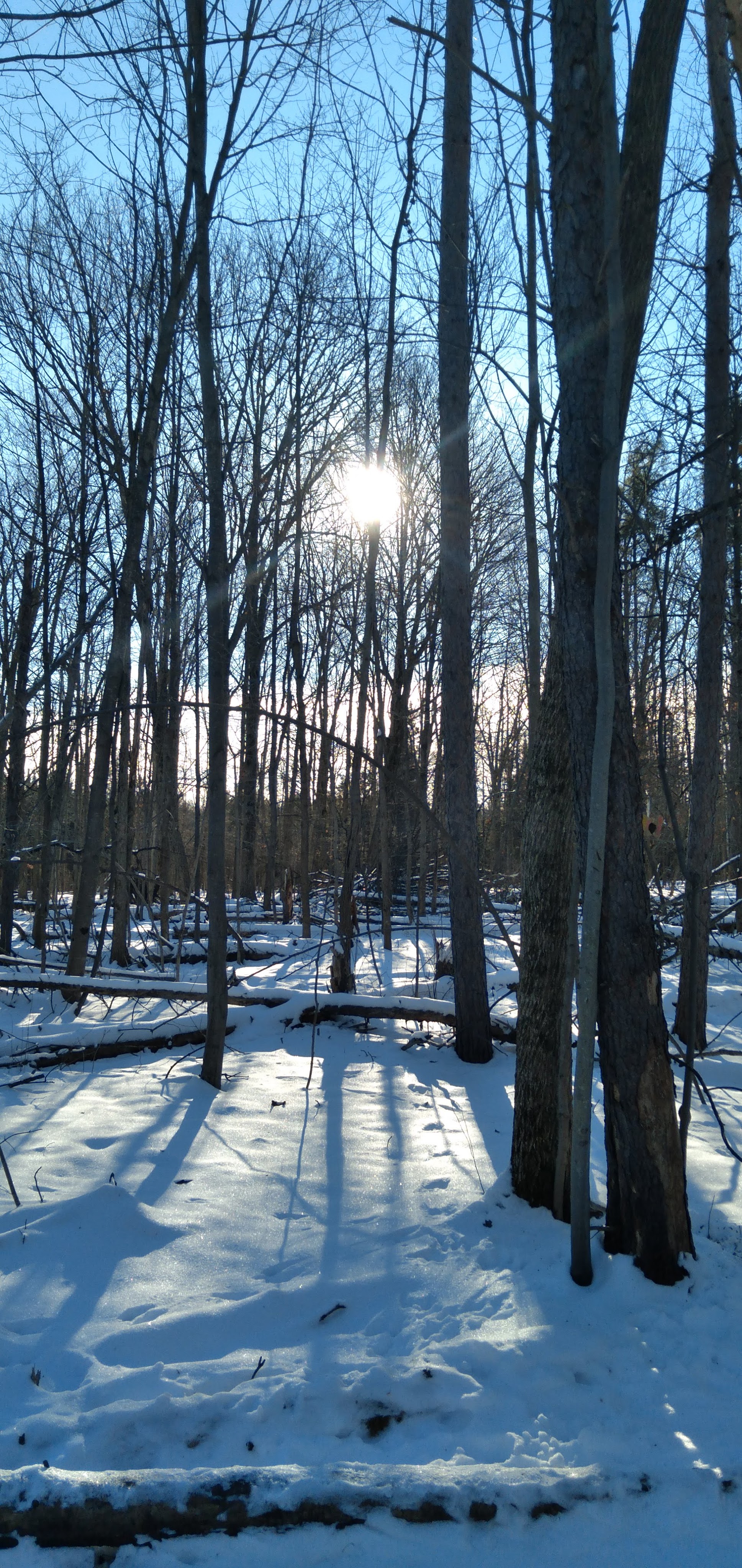
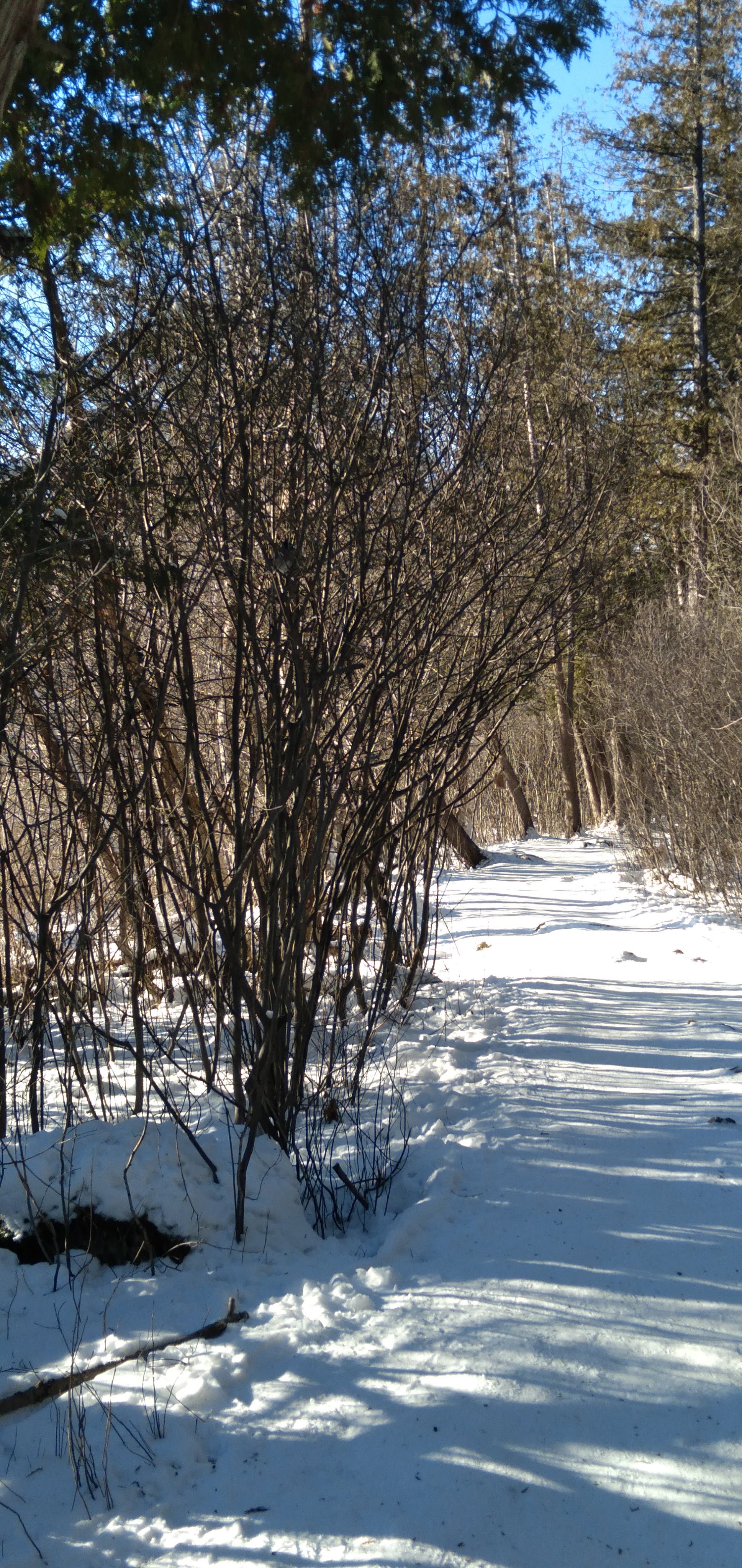
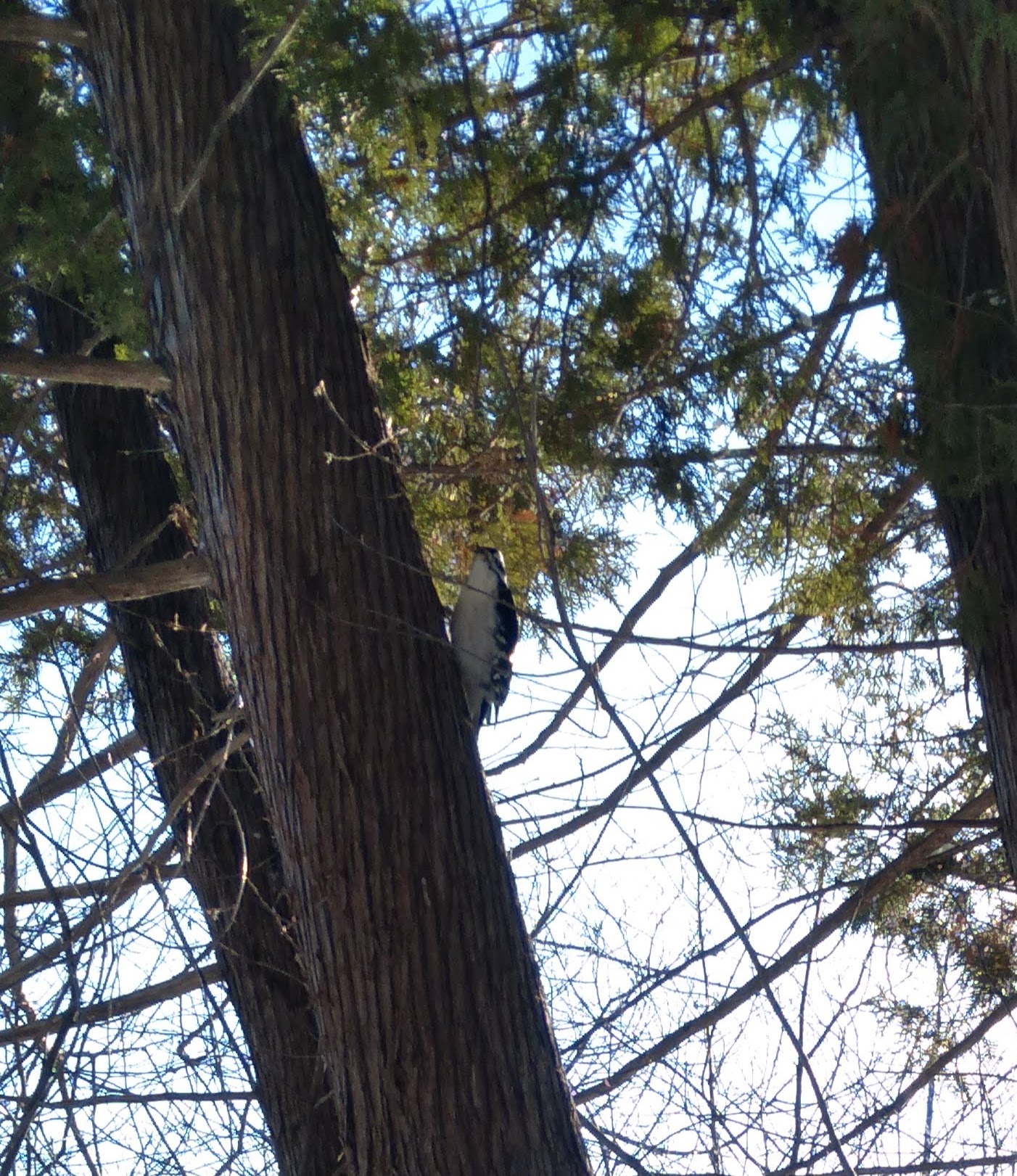
Beautiful, bright blue sky. Crisp white snow squeaking under foot. Half-fallen trees gently creaking against each other. Echoes of woodpeckers. Stubborn leaves clinging to twigs rustling in the barely-there breeze. Unseen critters scampering about. Cardinals, bluejays and squirrels competing for seeds that other walkers leave behind.

The only thing that could possibly make it better would be the sound of a gurgling brook or the water of a pond or lake lapping at a pebbly shore.

There were also plenty of other folks about, too – plenty enough that I (as a woman alone in the woods) felt safe, but not so many that it felt crowded. And, really, each time I encountered someone (duos and families for the most part), it was quite lovely – outdoorsy people are quite friendly, so there were a lot of hellos and it was very nice to have that interaction, even for just a few milliseconds at a time.

It’s an antidote, I tell you, for so much of what is going on and is a great way to clear out the cobwebs and rejuvenate your mind and spirit.

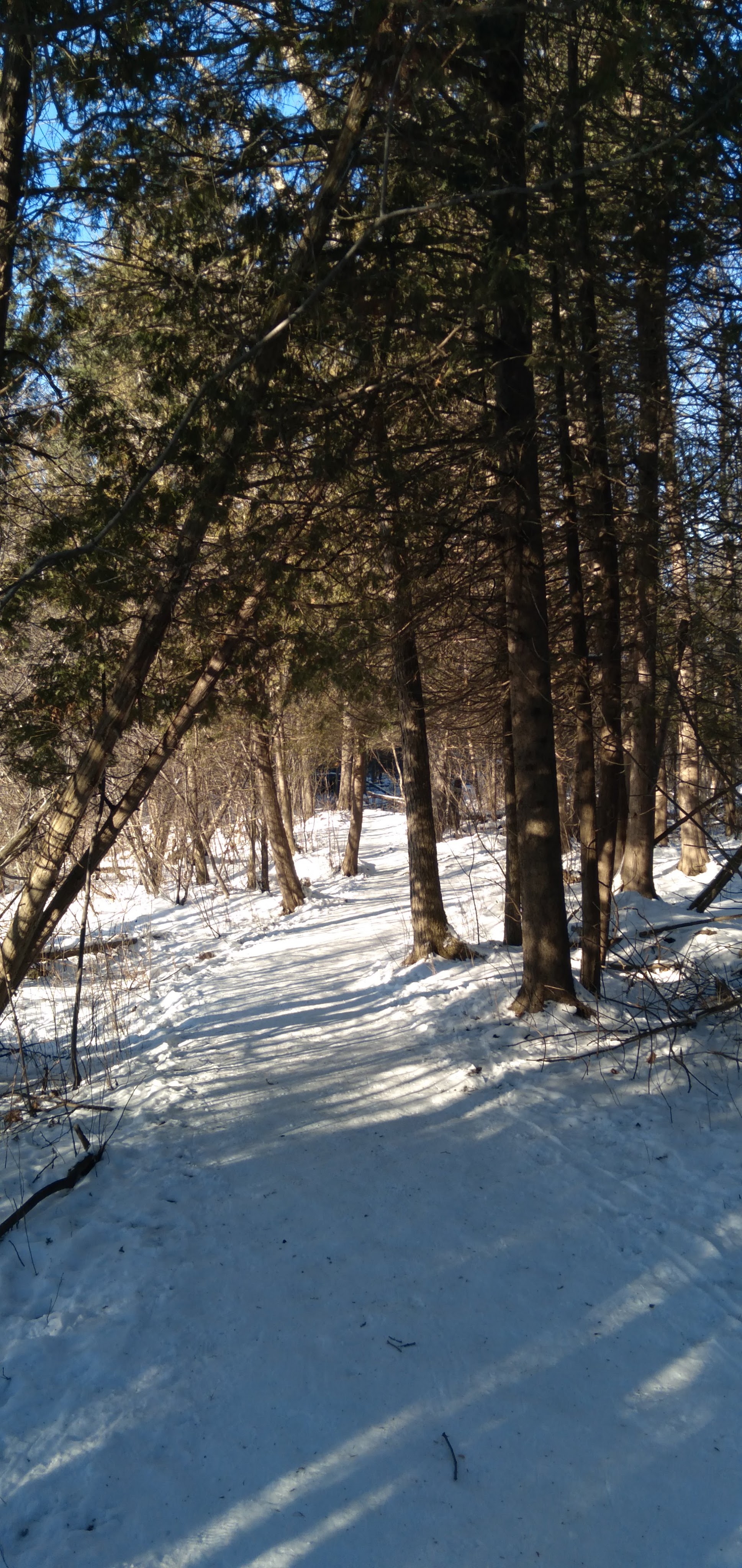
If you aren’t able to get out for your own mind refresher today, here are a few pictures that might help you place yourself there virtually. 🙂

(PS: I used to know how to put photos into these posts better, but there have been changes in how this is done and I can’t figure it out, so before my total zen from my walk is lost to technological frustration, I’m giving up and they are what they are. 🙂 )

A woodpecker looking for a snack.

Don’t forget to subscribe/follow to keep updated on new posts!


6 Comments

Becoming more aware – Our sphere of influence

I had intended to write more about this throughout last year. This post is long, I know, but it was either long or not at all, and it’s been “not at all” for months because I couldn’t do short.

Part of why I haven’t written more frequently is because I had the idea that as I did my reading, listening, learning and sitting with everything that I would naturally come to these plateaus of a-ha moments where I would have something specific that I could write about and share with you: “Hey – check out this thing that I just learned!”

But, it hasn’t worked out like that. There were just so many things that astounded me or punched me in the gut that I didn’t know where to go with it.

For example, I was floored…totally floored…to learn that the last federally funded residential school in Canada didn’t close until 1996. 1996!!!!! How is that even possible? Surely people knew. And obviously we didn’t care. So many heartbreaking things.

Anyway, there were so many things that I just got kind of paralyzed with it, I guess. A weird kind of writer’s block where, instead of not having any idea of what to write about, I had too many ideas and didn’t know where to start.

However, that is not to say that I hid my head under the sand with an “Oh well – there’s too much and what difference can one person make, anyway?” attitude.

If we were to all adopt that attitude nothing good would ever get done in this world.

So I kept reading and watching shows and videos, going out of my normal way to expose myself to things that would not have naturally shown up in my daily life, or that Instagram’s, YouTube’s or Google’s algorithms figured that a middle-aged white woman wanted to see. (As an aside – I think we all need to do that – we can’t wait for learning moments to just drop in our laps…we have to seek them out.)

Also I’m a firm believer in the power of making changes in our own individual little corners of the world. Specifically in this case, starting with myself. After all, I’m the only person that I have any real control over so the most sensible place to start is with me.

For myself, the thing I’ve been really working on is becoming more aware of my own unconscious biases. I know some people are struggling with that concept, but while it hasn’t always been easy to uncover what they are, the concept itself was easy for me to grasp and accept.

I mean, we have biases – conscious and unconscious – in probably all areas of our lives. At the most basic, they are like preferences. I grew up on the coast of Newfoundland, for example, with the sound of the ocean lulling me to sleep. To this day, my ideal peaceful moments involve being near the ocean (hence my Irish holiday for my 50th birthday in 2019) or at least near some sort of body of water. Conversely, people I know who grew up in or near the Rockies find the same thing with being near the mountains. Had we each been switched at birth somehow and I grew up in the Rockies and they grew up by the ocean, our preferences would very likely have changed with us.

Ditto with the types of food, music, language, traditions and so on that we all grow up with. Even if you celebrate Christmas, my idea of what an ideal Christmas involves is probably at least slightly different than yours.

If my preferences can be influenced by things I’ve been exposed to, then for me it was easy to extrapolate that idea to the opinions – biases – that I developed throughout my life in relation to people of other cultures and races growing up.

While I think I’m pretty awesome 🙂 I’m not, in fact, anybody special. As such, I’m not the only one who has those preferences or biases. We, all of us, have thoughts and ideas about people based on what we learn as we progress through our lives. Some we learn in school and from our families, some at work, some through people we encounter along the way, and so on. Some we might not even be aware of.

The first important step, I think, is for us to acknowledge that we have those biases.

Part of that is realizing, too, that having them doesn’t make us horrible people.

We ALL have them. It’s how our brains work. We are exposed to something; our brain makes sense of it based on previous knowledge/exposure – ideas are either changed or reinforced; and on we go. I’m not a psychologist so I’m sure I’m oversimplifying that, but you know what I mean. 🙂

It’s easier to combat the biases we are aware of. Not so much, though, with the ones we aren’t aware of.

As a next step, then, we can start to look at those things that we are aware of. There are a LOT of stereotypes about different groups. We can start with them. Think of the stereotypes about different groups of people. Think about a race, culture, group that is different from you, and come up with the things that “everybody knows” about that group.

A “nice” one is that “Everybody knows that Canadians are so polite.” Obviously we aren’t all polite and certainly not al the time. 🙂

Once we’ve done that, we can start to dig a bit deeper to see what unconscious biases we have.

Here are some questions that I’ve been asking myself and that might help you on your journey:

  • What things automatically come to my mind when I think about [X group – any group that is “other” than me]?
  • Where did those ideas come from?
  • Are they true? (Hint: No one thing is true about any complete group of people other than the fact that they are people. Hence the expression: We can’t paint everybody with the same brush.)
  • Do those ideas influence what I do or say or how I feel? (Do I cross the street when I seem someone from that group, for example?)
  • Am I willing to learn different things about that group?
  • Am I willing to try to change any of those ideas, beliefs or actions?

I’ve been doing a lot of this type of reflection the past several months.

And, yeah, it’s a lot of work. And nope, I don’t “have” to do it. Meaning that my life, as a white woman, won’t on the surface be negatively impacted if I don’t.

For example, I’ll still have my job. I had no issues recently renewing my mortgage. On paper, my name would put me as clearly white for many, if not most, people. I’ll go to dinner (once that’s allowed again!) and movies; park my car without someone writing a racial slur on it (which happened to a friend here in Ottawa within the past three years); and shop without someone following me around the store (which happens regularly to a friend of mine). Other than occasional sleights and issues because of misogynism and religious intolerance, my life is pretty comfortable and will stay that way.

So I could close the book now and call it a day.

But even though the surface of my life wouldn’t change if I did that, it would definitely impact me negatively as a person if I didn’t do this exploration.

This time last year, I wouldn’t have even thought to mention about how “white” my name is – and conversely how having a “Black” or “Indigenous” name can put someone’s application for a job or financing into a “Not gonna happen” pile. I was aware of those types of things – far back in my brain somewhere. But now it’s in the forefront and I truly believe that makes me a better person – a better member of my community, hopefully a better friend and also a better ally.

There’s still a lot for me to learn. But what I have learned so far has already helped me have conversations with people who don’t understand what this is all about and why people can’t just “get over it already”. I feel much more confident in my ability to explain things and have discussions that, hopefully, encourage people to think about things even just a little bit differently.

And, again, as I said earlier, I can’t change anybody but me. So this is where I have to start – and where I need to continue working.

I can change myself and at least influence things in my little corner of the world.

There’s a lot of power in that.


Don’t forget to subscribe/follow if you would like to be updated on future posts!


5 Comments

Memories: The furniture of your mind

I got an email from a friend recently that really touched me.

This person, whom I know from my days living in Calgary, AB, and I were an unlikely pair to become friends.

I was at the time, I think, in my early 30s and she was probably in her mid 50s. I was towards the beginning of my career and she was nearing the end of hers. I still had dreams of starting a family and she had finished raising hers. On the surface, it didn’t look like we had very much in common and the chances of our paths crossing organically were slim to nil.

But a chance Church assignment brought us together and resulted in one of the richest friendships I have had in my life.

It has been 13 years since we lived in the same city. In fact, we’ve both moved at least twice in that time. She has stayed in Alberta, but I have lived in Newfoundland and Ontario since then.

Distance friendships, like any relationship, can be difficult to maintain when there are thousands of kilometres in between, even in this day of technology. But we haven’t let that stop us!

Every couple of years we physically get together. She has either come to visit me, or I’ve gone there, but most frequently we meet up in another city and have a holiday together. Over the years we’ve visited Ottawa (before I lived here), Montreal, Toronto, Quebec City, Halifax and Boston. This year we were supposed to go to PEI for our next grand adventure, but the pandemic put the kibosh on that. It will wait for another year.

When we are together we do fun things, we have great conversations, (touching on the smallest topics to the greatest philosophical ideas and everywhere in between), we learn about the new places we are in, and we accept each other where we are. It’s wonderful. I always come away from a holiday (or any interaction with her) feeling like I am a better person than I was before.

So, as you can tell, we have had plenty of opportunities build a plethora of memories.

In the recent email I mentioned, my friend recounted many of those memories. It was lovely to relive them as I read her email. But it was the way she recounted them that really struck me. It was quite beautiful. Even if the email wasn’t about me and our shared memories, I would have still thought it a beautiful piece of writing in its own right.

The piece that really struck me and stayed with me was the following:

You have put beautiful furniture in my mind.

Isn’t that a fabulous way to think of our memories? What a gift we give each other when we share wonderful times together!

I’ve been thinking about it so much since I got the email a week or so ago. How we can choose to treat the beautiful memories as pieces of cherished, well-curated furniture that take pride of place in the forefront of our thoughts. (And, conversely, we can take the less than pleasant ones and put them in the basement or back room somewhere, out of sight.)

That way we can easily spend our time in the pieces that give us comfort and solace or joy and happiness whenever we want to revisit those moments, curled up on a literal sofa, with a cozy blanket, imagining ourselves in the beautiful pieces of the furniture in our minds.


If you enjoyed this post, don’t forget to select Follow for updates on new posts!


Leave a comment

I see colour

I used to think that was a bad thing to say. I’m not sure why – where the idea of not seeing the colour of someone’s skin became a bad thing. Somehow or other it became tied up with the idea of being racist or bigoted and if we wanted to be known as not being either of those two things we had to say “I don’t see colour.”

I’ve never liked that phrase, either, even though I’m sure I’ve said it.

But I didn’t believe it. I knew I saw colour. My eyes see what my eyes see. The same as I see the colour and style of someone’s hair, what type of clothes they are wearing, their jewellery – any number of physical characteristics about a person when I see them.

So it always seemed disingenuous to say it, or to hear it, even though it was what you were supposed to say.

I didn’t like it, then, because it just wasn’t true. Of course I saw the colour of someone’s skin. How ridiculous to say I didn’t.

Really, it’s insulting to all of us. I know I see it. You know I see it. You know I know I see it. But I’m afraid to admit that I see it because that will make me a bad person somehow. Because that’s what I’ve learned:

“If we could all just learn to not see colour, everything would be great.”

As you’ve probably noticed in your own journey, “I don’t see colour” has been a popular topic the past couple of months. I have learned that while it’s almost universally acknowledged that its origins may well have been well-intentioned, there is damage and hurt that occurs when we use it.

My first reaction was relief – I wasn’t a horrible person for not feeling right about saying it.

I then read more about it – to really understand why and how it was hurtful.

I’m so glad I did. As you can imagine, it’s not just about outright lying or denying diversity.

There are loads of negative things that simple, well-meant phrase can bring with it. Here are a just a few of things that I’ve learned that it can do:

  • disrupt conversations about racism
  • inadvertently support systemic racism
  • deny the experiences of those who have experienced the (overt and not-so-overt) impacts of racism, hatred and bigotry
  • make someone feel like you don’t see them

Perhaps the two biggest take-aways for me are first, the idea that if we deny that we even see colour – race – then we (even if unintentionally) deny that racism exists, and then second, that me saying that phrase could make someone feel like I don’t see them. How hurtful! Have you ever felt unseen? It’s an awful feeling. I would never want to make someone feel that way. Even if my intent in saying it is good, if it causes hurt, I need to re-evaluate.

I was going to list a bunch of resources for you to check out, but there really are too many. Just Google “I don’t see colour” (or “color” for our geographic neighbours to the south… 🙂 ) and you will have a plethora of experiences to read from. I promise you will find them valuable and eye-opening.

Also in my readings, I came across the research of Dr. Osagie K. Obasogie on the concept of race and colour blindness that is worth checking out. He talks about it in his book, Blinded by Sight: Seeing Race Through the Eyes of the Blind.

Or, for a shorter read, the Oxford University Press has a great interview with Dr. Obasogie and Henry Louis Gates, Jr. that is super interesting.

Don’t let the “Eyes of the Blind” bit of the title fool you. There is value in it for all of us to reflect on. I highly recommend checking it out. Here’s a quote to whet your appetite:

This research certainly gave me a new appreciation of the extent to which understanding and “seeing” race has very little to do with vision. That is the gist of the book, i.e. the social and institutional practices that we’re constantly engaged in shape the way we look at people and the way that we live our lives—even for people who are blind.

Dr. Osagie K. Obasogie

So, even if we all did somehow stop “seeing” race, there is obviously so much more going on in racism than rods, cones and optic nerves.

Another reason, to me, to take the time to pay a little more attention.


Know better, do better.


If you enjoyed this post, don’t forget to subscribe/follow!